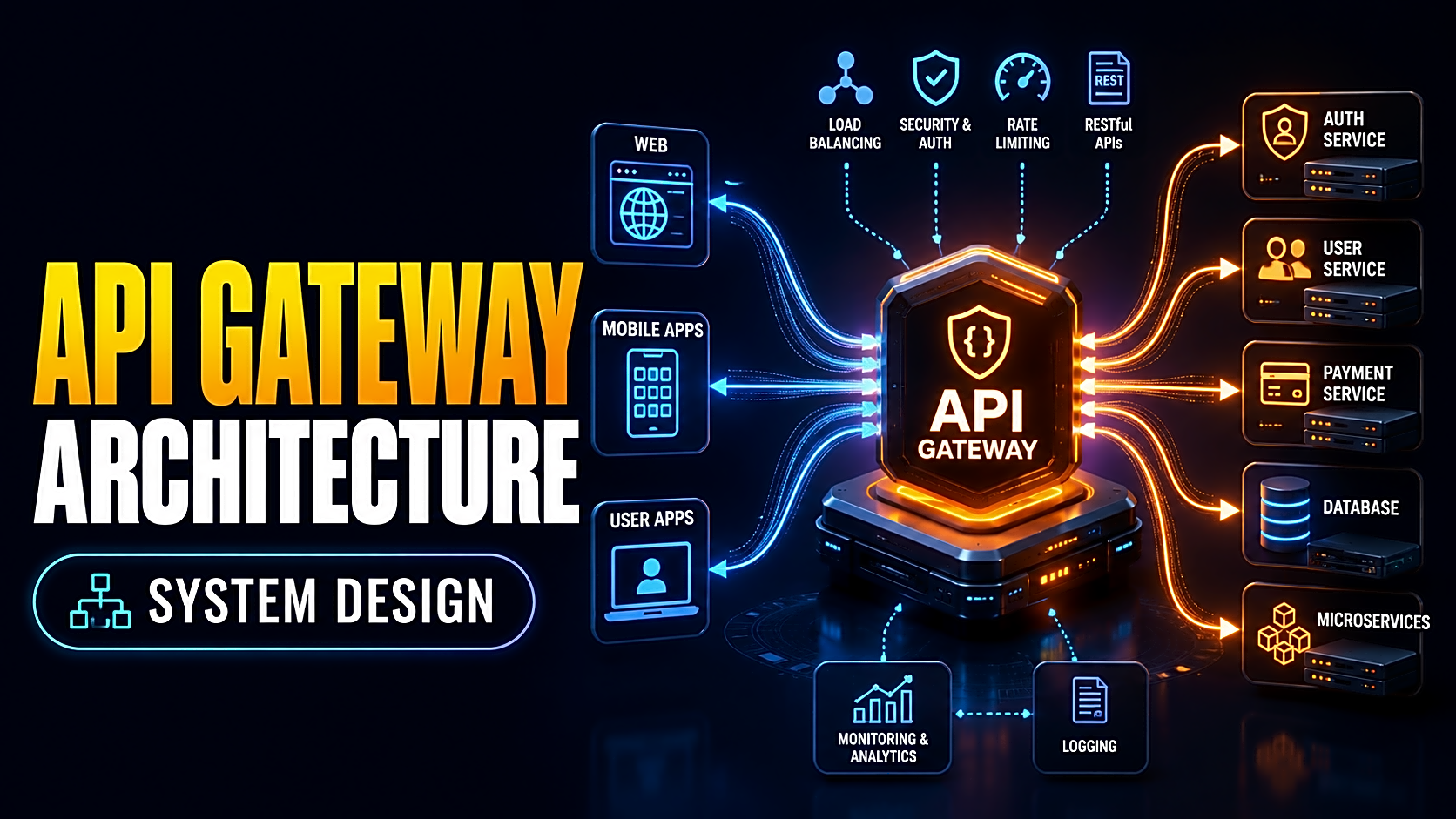
API Gateway Architecture: How It Works in System Design
A frontend talking to one backend is easy to understand. The architecture becomes more complicated when that application grows into separate authentication, user, payment, search, reporting, and notification services.
Now the client must know where every service lives, how each one is secured, which API version to call, and what happens when a service fails.
API Gateway architecture solves this problem by introducing a controlled entry point between clients and backend services. The gateway receives API traffic, applies shared policies, routes each request to the correct service, and returns the response.
For students learning system design, this pattern connects several important ideas—microservices, authentication, rate limiting, caching, observability, resilience, and API versioning—inside one understandable request flow.
Quick Answer: What Is API Gateway Architecture?
API Gateway architecture places a gateway between API clients and backend services.
A simplified request flow is:
Client → API Gateway → Authentication/Policies → Backend Service → Database → Response
The gateway can validate requests, enforce traffic policies, select backend services, transform selected requests or responses, aggregate data, and capture telemetry.
In microservices, it also hides internal service locations from external clients.
The gateway should generally remain a routing and policy layer, not become another large application containing core business logic.
How API Gateway Architecture Works
A normal request passes through several stages.
1. Client sends the request
A browser, mobile application, frontend, or partner system sends an HTTPS request to a public API endpoint.
2. Gateway validates the request
The gateway can check credentials, API keys, tokens, headers, payload size, or other edge policies.
3. Traffic policies are applied
Rate limiting and throttling protect backend capacity. For example, an excessive request rate can result in HTTP 429 Too Many Requests.
AWS API Gateway implements throttling using rate and burst controls.
4. Gateway routes the request
Routing can use:
- URL path;
- HTTP method;
- hostname;
- headers;
- API version.
For example:
/api/auth/* → Authentication Service
/api/students/* → Student Service
/api/payments/* → Payment Service
/api/reports/* → Report Service
5. Backend executes business logic
The destination service performs the actual application logic and accesses its database, cache, message queue, or external dependencies.
6. Response returns through the gateway
The gateway can record status, latency, target service and tracing information before returning the response.
Core Responsibilities of an API Gateway
A gateway may centralize:
- request routing;
- token validation;
- rate limits and quotas;
- TLS termination;
- CORS policies;
- API version routing;
- caching;
- request or response transformation;
- response aggregation;
- logging, metrics and trace propagation.
Not every application needs every capability.
One boundary is especially important: gateway authentication does not eliminate backend authorization.
A gateway may validate who the caller is, but the responsible backend should still verify whether that user can access a particular account, record, payment, report, or administrative function. OWASP identifies broken object-level authorization and broken authentication among major API security risks.
API Gateway in Microservices Architecture
Consider an application containing several independently deployed services:
Web / Mobile Client
↓
API Gateway
├── Auth Service
├── Student Service
├── Payment Service
├── Report Service
└── Notification Service
The frontend uses one public API while the gateway selects the appropriate internal service.
This reduces client coupling because internal service locations can change without requiring every client to know the new topology.
However, a gateway is not automatically an improvement.
A small application with one backend may be easier to build as a modular monolith behind a conventional reverse proxy. Add an API gateway when multiple services, external APIs, centralized policies, version routing, or client-specific APIs create a genuine need.
API Gateway vs Load Balancer vs Reverse Proxy
|
Component |
Primary Role |
Typical Routing |
API Policies |
Best Fit |
|
API Gateway |
API management |
Path, method, header, version |
Extensive |
APIs and microservices |
|
Load Balancer |
Traffic distribution |
Backend health and balancing |
Limited |
Scaling and availability |
|
Reverse Proxy |
Request forwarding |
Host/path |
Basic–moderate |
Proxying and TLS |
These categories overlap. A product can perform multiple functions, but their architectural purpose differs.
API Gateway vs Service Mesh
A useful starting distinction is:
API Gateway: mainly manages external client-to-service or north-south traffic.
Service Mesh: mainly manages internal service-to-service or east-west traffic.
The distinction is not absolute. Modern service meshes can expose ingress gateways, and the two technologies can coexist.
For example:
External Client
↓
API Gateway
↓
Service Mesh
├─ Order Service
├─ Payment Service
└─ Inventory Service
Microsoft notes that mesh ingress can participate in the same mTLS, identity, authorization and telemetry environment used for internal mesh traffic.
Key API Gateway Patterns
Gateway Routing
One public endpoint forwards requests to multiple services.
Gateway Offloading
Common concerns such as TLS, authentication checks, logging, CORS or rate limiting are handled centrally instead of being duplicated across every service.
Gateway Aggregation
One client request triggers multiple service calls and combines their responses.
This can reduce client round trips, but a slow dependency can increase the total response time.
Backend for Frontend
A Backend for Frontend (BFF) provides different gateway-style APIs for different client types.
A mobile application, for example, may need smaller responses than a desktop web interface. Microsoft documents BFF as an established gateway-related architecture pattern.
Production API Gateway Architecture
A production-oriented design normally needs more than one gateway process:
Client
↓
DNS / CDN / WAF
↓
Load Balancer
↓
API Gateway Instances
↓
Service Discovery
↓
Microservices
↓
Database / Cache / Queue
The gateway itself should not become an avoidable single point of failure.
Where availability matters:
- run redundant gateway instances;
- keep them stateless where practical;
- use health checks;
- define backend timeouts;
- route only to available service instances;
- monitor latency and failure rates.
Service Discovery
Hard-coded backend addresses become difficult to manage when services scale dynamically.
Instead, the gateway can discover healthy service destinations through DNS, orchestration platforms, service registries, or another controlled discovery mechanism.
Retries and Circuit Breakers
Retries should be bounded and limited to failures likely to be temporary.
Do not blindly retry non-idempotent actions such as payments or order creation.
A circuit breaker can temporarily stop calls to an unhealthy dependency rather than repeatedly sending traffic into a known failure.
API Gateway Implementation Example
You do not need an expensive enterprise platform to demonstrate the pattern.
This simplified NGINX configuration shows routing, authentication through an internal auth endpoint, and rate limiting:
limit_req_zone $binary_remote_addr zone=api_limit:10m rate=10r/s;
upstream student_service { server student-service:3001; }
upstream report_service { server report-service:3002; }
server {
listen 443 ssl;
location = /_auth {
internal;
proxy_pass http://auth-service:3000/verify;
proxy_pass_request_body off;
proxy_set_header Authorization $http_authorization;
}
location /api/students/ {
auth_request /_auth;
limit_req zone=api_limit burst=20 nodelay;
proxy_pass http://student_service;
}
location /api/reports/ {
auth_request /_auth;
proxy_pass http://report_service;
}
}
This is deliberately minimal. A real deployment also needs TLS certificates, safe header forwarding, timeouts, monitoring, error handling and an availability strategy.
API Gateway Security Best Practices
Treat the gateway as an important security boundary—but not the only security boundary.
Use:
- HTTPS/TLS;
- JWT, OAuth/OIDC or appropriate API credentials;
- payload-size restrictions;
- rate limits;
- narrow CORS policies;
- safe secret handling;
- sanitized logs;
- backend authorization;
- a WAF where justified;
- controlled API-version inventory.
OWASP's API Security Top 10 also highlights unrestricted resource consumption and improper API inventory management, both of which are relevant when gateways expose and control public APIs.
Observability and Distributed Tracing
An API gateway is a natural place to create or propagate request context.
Monitor:
- request volume;
- route;
- HTTP status;
- authentication failures;
- throttled requests;
- timeout count;
- backend target;
- p50, p95 and p99 latency.
For distributed applications, propagate trace context rather than generating unrelated identifiers in every service.
OpenTelemetry describes context propagation as what allows telemetry across distributed services to be correlated, while the W3C traceparent header provides a standardized HTTP trace context.
Example:
Client
↓
Gateway [traceparent]
↓
Order Service
↓
Payment Service
This makes a single request easier to follow across multiple components.
Students can connect this section with FileMakr's application logging and monitoring guide.
Failure Scenarios You Should Test
Do not demonstrate only successful 200 OK responses.
|
Scenario |
Typical Response |
|
Missing or expired token |
401 Unauthorized |
|
Authenticated but not permitted |
403 Forbidden |
|
Request limit exceeded |
429 Too Many Requests |
|
Backend unavailable |
503 Service Unavailable |
|
Backend timeout |
504 Gateway Timeout |
The exact status depends on your implementation, so configure and document the behaviour explicitly.
For a project report or viva, capture the request, gateway response, gateway log and service log for at least one rejected request and one backend failure.
Common API Gateway Mistakes
Avoid:
- database queries inside the gateway;
- core business logic in gateway rules;
- retrying every failure;
- one gateway instance with no recovery plan;
- caching sensitive responses carelessly;
- exposing internal services unnecessarily;
- hard-coded service addresses;
- unlimited payloads or request rates;
- logging passwords or tokens.
The best gateway is usually predictable rather than clever: explicit routing, clear policies, observable behaviour and limited responsibilities.
Frequently Asked Questions
What is API Gateway architecture in simple words?
It places one controlled entry point between clients and backend services so API requests can be authenticated, controlled, routed and monitored consistently.
Why is an API gateway used in microservices?
It gives clients a stable public interface while hiding internal service locations and centralizing selected API policies.
Does every project need an API gateway?
No. A single-backend application often does not need one. Add a gateway only when the architecture creates a genuine routing or policy-management requirement.
Is an API gateway the same as a load balancer?
No. A load balancer primarily distributes traffic among backend instances, while an API gateway focuses on API-aware routing and policies. Some technologies support both.
What is API Gateway vs Service Mesh?
An API gateway primarily manages incoming client/API traffic, while a service mesh primarily manages communication between services. They can work together.
Can an API gateway become a single point of failure?
Yes. If the gateway layer has no redundancy, its failure can block access to several services.
How do you secure an API gateway?
Use TLS, strong authentication, rate and payload limits, careful CORS configuration, safe logging, appropriate WAF controls and backend authorization.
What should an API Gateway architecture diagram contain?
Show clients, the gateway, authentication and traffic policies, load balancing where applicable, service discovery, backend services, databases, caches or queues, and observability components.
Conclusion
API Gateway architecture gives distributed applications a controlled front door. It simplifies client communication, centralizes selected API policies and routes requests to the correct services.
The strongest design is not the architecture with the most components.
Start with the simplest architecture that satisfies the requirement. If an API gateway is justified, implement routing first and then add authentication, rate limits, timeouts, observability, resilience and failure testing.
For a student system-design project, that provides something more valuable than an enterprise-looking diagram: an architecture you can explain, implement, test, measure and defend.
If you are still deciding what architecture to implement, explore FileMakr's final-year project ideas or browse relevant project source code before selecting unnecessary infrastructure.
The revision deliberately adds evidence and engineering reasoning rather than merely expanding word count. That better matches Google’s current guidance around providing substantial value beyond obvious or derivative coverage.