Microservices Architecture for Final-Year Projects: A Practical Guide
Learn how to choose service boundaries, manage data, prevent failures, and build a microservices project you can explain confidently during viva.
A student project usually begins as one backend, one database, and one deployment. That is often the right decision. Problems begin when authentication, orders, payments, reports, notifications, and analytics become tightly connected. A small change may then require retesting and redeploying the entire application.
Microservices architecture divides an application into independently deployable services aligned with business capabilities. Each service owns a focused responsibility, communicates through a defined API or event contract, and can evolve with less dependence on the rest of the system.
That flexibility is not free. Microservices introduce network failures, distributed data, more deployments, harder testing, and greater security and monitoring requirements. For a final-year project, the goal is not to create the most services. It is to design the smallest architecture that demonstrates meaningful independence.
Quick Answer: What Is Microservices Architecture?
Microservices architecture is a software design approach in which an application is built as a collection of small, loosely coupled, independently deployable services. Each service represents a specific business capability—such as users, orders, payments, or notifications—and normally controls its own logic and data.
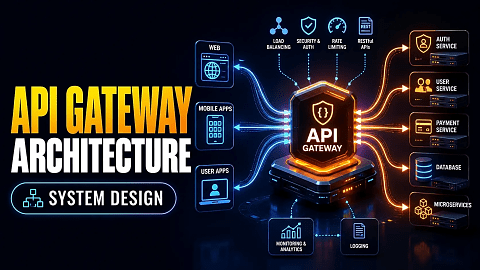
A client may see one application, but several services can collaborate behind the interface. An order request may pass through an API gateway, create an order, verify payment, reserve inventory, and publish an event that triggers a notification.
Core Components of a Microservices Architecture
|
Component |
Purpose |
Student-friendly option |
|
API gateway |
Routes client requests through one entry point |
Nginx or Spring Cloud Gateway |
|
Business services |
Implement bounded capabilities |
Node.js, Spring Boot, Django, or Flask |
|
Service-owned data |
Prevents direct table dependency |
Separate databases or schemas |
|
Communication |
Connects services synchronously or asynchronously |
REST, gRPC, RabbitMQ, or Kafka |
|
Resilience |
Limits cascading failures |
Timeouts, retries, and circuit breakers |
|
Observability |
Connects logs, metrics, and traces |
OpenTelemetry-compatible tools |
|
CI/CD and containers |
Automates reliable delivery |
GitHub Actions and Docker Compose |
The gateway may authenticate, route, rate-limit, and log traffic, but business logic should remain inside services. “Database per service” means data ownership; a student project may use isolated schemas while preventing direct cross-service queries. AWS identifies service-owned data as a mechanism for reducing coupling and improving service independence.
Microservices Example: Online Food Ordering System
|
Service |
Main responsibility |
Owned data |
|
Identity |
Login, profiles, roles |
Users and addresses |
|
Restaurant |
Menus and availability |
Restaurants and menu items |
|
Order |
Order creation and status |
Orders and order items |
|
Payment |
Verification and refunds |
Transactions |
|
Delivery |
Rider assignment and tracking |
Delivery tasks |
|
Notification |
Email, SMS, and app alerts |
Templates and logs |
A practical payment flow works like this:
- The client sends POST /orders through the gateway.
- The Order Service creates an order with PAYMENT_PENDING.
- The Payment Service verifies the transaction and publishes PaymentCompleted.
- The Order Service changes the status to CONFIRMED.
- The Notification Service sends confirmation independently.
If notification delivery fails, the order should remain confirmed. The failed message can be retried or moved to a dead-letter queue. This demonstrates real fault isolation, not merely several folders running on different ports.
Monolithic vs Microservices Architecture
|
Factor |
Modular monolith |
Microservices |
|
Deployment |
One application |
Independent services |
|
Data |
Usually one database |
Service-owned data |
|
Communication |
In-process calls |
APIs or events |
|
Scaling |
Scale the full application |
Scale selected services |
|
Testing |
Simpler |
More contract and integration testing |
|
Operations |
Better for small teams |
Requires automation and observability |
|
Best fit |
Small or moderate systems |
Evolving systems with clear boundaries |
Microservices are not automatically more scalable or maintainable. A badly separated system becomes a distributed monolith: services are deployed separately but still depend on one another’s data, release timing, and availability.
For one to three developers with a short deadline, a modular monolith is usually stronger. Choose microservices only when independent deployment, scaling, ownership, or failure isolation creates demonstrable value. Microsoft’s current readiness guidance similarly recommends evaluating application, infrastructure, DevOps, and organizational maturity before adopting microservices.
How to Choose Service Boundaries
Start with business capabilities, not database tables or technical layers. “Order management” is a useful boundary; separate “controller,” “validation,” and “database” services usually are not.
Domain-driven design uses a bounded context to define where a business model and vocabulary remain consistent. Microsoft and AWS both recommend using business domains and bounded contexts to identify service boundaries.
Use these tests:
- The service has one cohesive business responsibility.
- It owns data without direct table access from other services.
- It can be changed with limited release coordination.
- Its API exposes business actions, not internal tables.
- A temporary failure does not disable the entire application.
Three to five meaningful services are enough for most final-year projects.
How Microservices Handle Transactions
A business workflow across service-owned databases cannot normally use one rollback. Microservices often use eventual consistency and the Saga pattern. A saga breaks a workflow into local transactions and defines compensating actions if a later step fails.
For example, if payment succeeds but inventory reservation fails, the workflow issues a refund, cancels the order, and informs the user.
The transactional outbox pattern makes event publishing safer. A service records its business update and an outbox message in one local transaction; a separate process publishes the message. Consumers should also be idempotent, so processing PaymentCompleted twice does not confirm or charge an order twice.
How to Prevent Cascading Failures
Use timeouts so requests do not wait indefinitely. Retry only transient failures, apply backoff, and limit attempts. A circuit breaker temporarily stops calls to a repeatedly failing dependency. Bulkhead isolation prevents one exhausted resource pool from consuming the entire system. Microsoft describes circuit breakers as a way to stop repeated calls to a failing resource and give it time to recover.
For asynchronous workflows, move repeatedly failing messages to a dead-letter queue. A strong viva test is to stop the Notification Service and place an order. The order should complete, the notification should fail visibly, and a retry should succeed after the service returns.
Testing, Observability, and Security
Use layered testing:
- Unit tests for service logic.
- Service-component tests with dependencies replaced.
- API and consumer-driven contract tests.
- Integration tests for databases, brokers, and gateway routing.
- Selected end-to-end tests for critical workflows.
Contract tests verify that a service continues to satisfy the expectations of its consumers without requiring every service to be deployed for every test.
Add a correlation or trace ID at the gateway and propagate it through API calls and events. Distributed tracing then shows how one request moved across services. Track request rate, latency, errors, queue depth, and health status. OpenTelemetry describes distributed tracing as especially important for understanding requests across complex distributed systems.
Security must exist at gateway and service levels. Validate tokens, enforce role and object-level authorization, protect secrets, use HTTPS, and restrict internal endpoints. OWASP warns that internal microservices remain vulnerable when they can be accessed without authentication or use weak token controls.
A 2026 exploratory study covering 216 master’s students across 67 teams found security anti-patterns were the most frequent category in their microservices projects. The researchers concluded that students commonly prioritized feature delivery over robustness and operational discipline.
Implementation Guide for a Student Project
1. Define the workflow
Write the user journey, failure cases, and business capabilities.
2. Select three to five services
Choose cohesive domains. Avoid one service per table or CRUD screen.
3. Document contracts
Define endpoints, payloads, status codes, authentication, versioning, and event formats before integration.
4. Enforce data ownership
Other services must use the owner’s API or events rather than its tables.
5. Choose communication deliberately
Use REST for immediate queries and events for independent follow-up actions such as notifications or analytics.
6. Add failure controls
Implement timeouts, bounded retries, idempotency, circuit breakers, and dead-letter handling where relevant.
7. Containerize locally
Use one Docker image per service and Docker Compose for networks, health checks, databases, and a broker. Kubernetes is unnecessary for most academic projects.
8. Automate testing and builds
Run tests, linting, and image builds through CI. Separate development, testing, and deployment configuration.
9. Instrument the system
Add structured logs, trace IDs, metrics, and health endpoints before failure testing.
10. Prepare viva evidence
Include service, sequence, deployment, API, event-flow, and data-ownership diagrams, plus a test matrix and architecture decision records.
Common Microservices Mistakes
Avoid creating too many tiny services, sharing one database without ownership rules, using long synchronous call chains, ignoring API versioning, retrying non-idempotent requests, deploying manually, logging without trace IDs, and adding Kubernetes only to look advanced.
A good architecture is one you can justify: why each boundary exists, what happens when a dependency fails, how data becomes consistent, and how the system is tested.
Frequently Asked Questions
How many microservices should a final-year project have?
Three to five well-defined services are usually sufficient. More services increase deployment, testing, and monitoring effort.
Does every microservice need a separate database?
Each service should own its data. Separate databases are ideal, but isolated schemas can be acceptable when ownership rules are enforced.
How do microservices communicate?
They use synchronous REST or gRPC APIs and asynchronous events through brokers such as RabbitMQ or Kafka.
Are Docker and Kubernetes required?
No. Docker is practical for consistent local deployment. Kubernetes is usually unnecessary unless orchestration is a learning objective.
What is the Saga pattern?
A saga coordinates a multi-service workflow through local transactions and uses compensating actions when a step fails.
What is the biggest disadvantage?
Distributed-system complexity: communication, consistency, security, testing, deployment, and observability become harder.
Which diagrams should the report include?
Include system-context, service-architecture, sequence, deployment, API-flow, event-flow, and database-ownership diagrams.
When should students avoid microservices?
Avoid them when the deadline is short, boundaries are unclear, or the team cannot automate testing and deployment.
Conclusion
Microservices architecture separates business capabilities into independently deployable services. Its strengths include selective scaling, clearer ownership, isolated releases, and fault containment. Its costs include network failures, eventual consistency, contract management, security, and operational overhead.
For a final-year project, choose the simplest architecture that proves the requirements. Use microservices only when you can justify the boundaries, demonstrate independent deployment, handle failures safely, and explain the trade-offs during viva.
Explore FileMakr’s final-year project ideas, working demos, source-code projects, and project-report resources to choose an architecture you can build, test, document, and defend confidently.
Estimated article-body length: approximately 1,560 words, excluding metadata and citations.