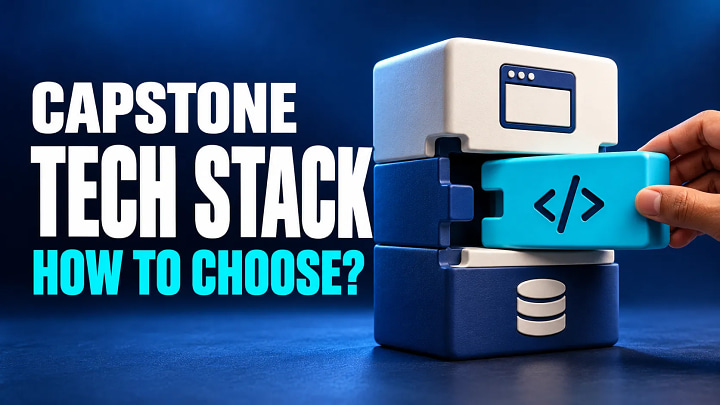
Choose a capstone tech stack around the system you must build, the skills your team can demonstrate and the conditions of your final presentation. A suitable combination lets you build the essential workflow, test its behavior and explain the tradeoffs in your report and viva.
This guide focuses on software and computing capstones. It compares practical options and provides a scorecard, decision worksheet and prototype check to help you justify your choice.
What Is a Tech Stack in a Capstone Project?
A tech stack is the combination of technologies used to build and run a project. A web application typically needs an interface, application logic and data storage, alongside testing tools and a runtime environment.
For example, MERN combines MongoDB, Express, React and Node.js: MongoDB stores documents, Express supports backend routes, React builds the interface and Node.js runs the server code. MongoDB's MERN explanation describes these component relationships.
An API, or application programming interface, defines how software components exchange requests and responses. A booking screen might call a backend API that checks permissions, applies booking rules, accesses the database and returns a result.
A data-analysis capstone may need Python, notebooks and datasets without a separate web frontend. A server-rendered application can also complete many workflows without a separate React frontend; add a frontend library when its interaction benefits justify the integration work. Mobile and hardware projects also require device, operating-system, driver or sensor compatibility checks beyond this guide's examples.
Check Requirements and Team Constraints First
Treat mandatory requirements as pass/fail gates before comparing preferences. A high score cannot compensate for a prohibited language, unavailable dataset or compulsory offline demonstration that depends on a remote service.
Check your department's actual rubric, supervisor instructions and rules on external code. For BCA, MCA, B.Tech and BE students, requirements depend on the programme; do not assume one college's approved stack applies everywhere.
Then compare six factors:
- Feature fit: Can the tools support the essential workflow?
- Team capability: Who can build, debug and explain each layer? Include access to a guide or teammate who can help resolve unfamiliar errors.
- Time: Include learning, integration, testing, reporting and presentation.
- Environment: Check equipment, installation permissions and demo conditions.
- Budget and access: Include hosting, APIs, renewals, quotas and account ownership. Check availability during the assessment period, not only during development.
- Assessment evidence: Identify how you will demonstrate correctness and individual contributions.
Define the essential features using a capstone scope plan. Use the guide to judging capstone difficulty to assess the learning effort before committing.
Compare Practical Stacks for Software Capstones
These are starting points, not rankings. Suitability depends on your requirements and demonstrated skills.
| Stack option | Useful starting situation | Advantage | Work to account for |
|---|---|---|---|
| HTML/CSS/JavaScript, PHP, MySQL | A PHP/SQL team building records or management workflows | Uses existing web and relational-data skills | Permissions, validation, queries and server setup |
| Django templates, Python, PostgreSQL or SQLite | A Python team building a data-backed application | Integrated authentication and administration tools | Framework conventions, data modeling and deployment |
| React, Express, Node.js, MongoDB | A JavaScript team building an interactive web application | JavaScript across interface and server code | API integration, access control and document design |
| React, Express, Node.js, PostgreSQL | An interactive interface with relational data requirements | Separate frontend with relational storage | API contracts, migrations and transaction design |
| Java, Spring Boot, MySQL or PostgreSQL | A Java team building a backend service or application | Builds on existing Java skills | Framework configuration, persistence and interface integration |
| Python, pandas, scikit-learn, optional interface | A tabular ML or analysis project | Tools for data preparation, modeling and evaluation | Dataset suitability, leakage prevention and reproducibility |
Django's overview documents authentication and administration features; they do not replace application-specific permissions or testing. Spring Boot's official overview describes standalone Spring applications, but your team must still configure and test its own workflow.
If inspecting an implementation would help your shortlist, FileMakr's Node.js project examples provide a relevant starting point. Verify the actual components and setup requirements of the specific project.
How Do You Choose the Database?
Choose a database according to relationships, queries, consistency rules and operating conditions. React does not require MongoDB, and Python does not require one particular SQL database.
For example, an equipment-booking application relates users, equipment and reservations. It may need to list a user's bookings, calculate availability for a time interval and prevent conflicting allocations. A relational design can represent these relationships, but correct concurrency handling still requires deliberate implementation and testing. Merely selecting SQL does not prevent double booking.
A document database can suit records retrieved as documents, provided validation, indexes and consistency rules match the workload.
SQLite avoids running a separate database server and can simplify appropriate local projects. It allows one writer at a time per database file; that does not rule out every multi-user application. Consult SQLite's official selection guidance and test the expected workload before choosing embedded or client/server storage.
Seven Steps to Select and Validate Your Stack
1. Describe the smallest complete workflow
Write what one user must accomplish from beginning to end. For equipment booking: sign in, check availability, reserve an item and cancel the reservation. List acceptance checks and keep optional extensions separate.
2. Record constraints and responsibilities
Write the deadline, available hours, required technologies, hardware and presentation conditions. Assign an owner to each layer. Use prior work or a small exercise to check familiarity rather than relying on confidence alone.
3. Shortlist two feasible combinations
Remove candidates that fail mandatory gates. Compare two combinations that support the workflow and leave capacity for evaluation and documentation. Check licences, permitted code reuse, compatible supported versions and access to required services.
4. Score the remaining options
Set criterion weights before assigning ratings. Record a reason and supporting evidence for each score. Mark an untested assumption as provisional; do not treat a high rating as a passed test. Use the worked example below as a planning template, adjusting the weights to your constraints.
5. Prototype the highest-risk behavior
Test the uncertainty most likely to block delivery. For booking, test conflicting requests; for ML, test the dataset, baseline and evaluation pipeline.
Hypothetical booking acceptance test: Start with one available unit and submit two simultaneous requests for overlapping reservation periods. Expect one confirmed allocation, an explicit rejection for the other request and no conflicting confirmed records. Restart the application and check that the saved state remains correct.
Record the environment, input, expected outcome, actual outcome, errors and pass/fail decision. For the conflict test, identify both request IDs and inspect the stored reservations, so two successful screens cannot conceal duplicate allocation. Leave the actual outcome unfilled until the test runs. Also check that one student cannot cancel another student's booking and that a permitted cancellation restores availability. Allocation correctness does not establish authorization correctness.
For a tabular ML prototype, establish a simple baseline, keep evaluation data out of fitting and learned preprocessing, and check that a saved pipeline reproduces predictions on fixed inputs. Choose metrics that match the prediction task; a functioning prediction screen alone does not establish model quality. These checks test selected assumptions, not complete system reliability.
6. Reproduce setup and demonstration
Ask another member to follow the README in a fresh environment. Check:
- Compatible supported runtime and dependency versions are recorded.
- Installation, configuration, migrations and synthetic seed-data commands work.
- Credentials stay outside shared code; a safe configuration example is supplied.
- The essential workflow survives a shutdown and restart.
- A backup can be restored into a separate test database.
- If offline operation is required, the complete workflow works with the network disconnected.
Check remote APIs, login providers, fonts and other hosted assets. A local server does not make those dependencies available offline.
7. Record the decision and fallback
Finalize the choice after mandatory gates, the critical prototype and setup checks pass. Record what remains untested, the main tradeoff and your fallback. Review changes to approved commitments with your supervisor.
Worked Example: Comparing Two Feasible Options
Suppose three students know Python, have eight weeks and need a local equipment-booking demonstration. Both candidates meet their assumed mandatory requirements.
The weights and ratings below are hypothetical planning judgments, not measured technology benchmarks. Rate 1 for a weak fit with major unresolved gaps, 3 for a feasible fit with identified work remaining, and 5 for a strong fit supported by prior work or a relevant prototype. Use 2 or 4 between those anchors and record evidence for each rating.
| Criterion | Weight | Django + PostgreSQL | MERN |
|---|---|---|---|
| Required feature fit | 25 | 5 | 5 |
| Existing team skills | 25 | 4 | 2 |
| Setup and demonstration fit | 20 | 4 | 3 |
| Time to integrated essential workflow | 15 | 4 | 2 |
| Testing and explanation readiness | 10 | 4 | 3 |
| Budget fit | 5 | 4 | 4 |
| Weighted total /100 | 100 | 85 | 63 |
Calculate each contribution as weight × rating ÷ 5. Django's feature fit contributes 25 × 5 ÷ 5 = 25 points; skills contribute 25 × 4 ÷ 5 = 20. Adding all contributions gives 85, compared with 63 for MERN.
Django is the provisional choice for this assumed team. These scores assume the stated capability judgments; they are not results from an observed student team. Record a reason beside each rating, such as completed Python coursework or a successful setup exercise.
Check how assumptions change the result: If a JavaScript-experienced team rates MERN at 4 for skills, setup, time to the essential workflow and testing readiness, while retaining feature fit 5 and budget fit 4, MERN also scores 85. The calculation changes the planning comparison; it does not prove either system works. Use the prototype to resolve the uncertainties that actually differ between candidates.
Capstone Tech Stack Decision Worksheet
Copy this worksheet into your planning document. Complete it with your own requirements and observations.
| Field | Your entry |
|---|---|
| Essential workflow | User, actions and completion condition: ______ |
| Mandatory gates | Rubric, required language, data access, equipment and demo conditions: ______ |
| Candidate A / B | Interface, backend, database and runtime for each: ______ |
| Ownership | Who implements and explains each layer: ______ |
| Comparison | Weights, ratings and evidence for each criterion: ______ |
| Critical assumption | Behavior or dependency most likely to block delivery: ______ |
| Prototype record | Environment, input, expected result, actual result, errors and pass/fail: ______ |
| Repeatable setup | Versions, commands, synthetic data, restart and restore check: ______ |
| Dependencies and permissions | Costs, accounts, expiry, quotas, licences, data restrictions and institutional reuse rules: ______ |
| Final decision | Chosen stack, justification, untested limits, fallback and review date: ______ |
Common Stack-Selection Mistakes
- Choosing by popularity. Compare requirements and demonstrated capability instead of a framework's reputation.
- Learning every layer at once. Include learning and integration work in your estimate. Keep familiar foundations where possible and limit the unfamiliar component.
- Assuming free access will last. Check current quotas, trial expiry, renewals and account ownership. Record a fallback for a required API or hosting service.
- Adding services without a requirement. Each service creates another setup and integration responsibility. Use separation where the objectives justify it.
- Treating framework features as proof of correctness. Test server-side permissions, validation and failure paths in your application. Use synthetic demonstration data where appropriate and check a provider's data restrictions before uploading real information.
- Evaluating ML only after building the interface. Establish a baseline and suitable evaluation first. Keep test data out of model fitting and learned preprocessing, as explained in scikit-learn's common pitfalls guide.
How to Explain the Choice in Your Report and Viva
Connect each technology to a requirement, compare a realistic alternative and state what your tests establish. Trace one request from interface to backend to database, identifying where validation and permissions apply.
Completed hypothetical justification:
We provisionally selected Django and PostgreSQL because our team knows Python and the project requires related booking records. We compared MERN but identified more unfamiliar integration work. We will confirm the choice after testing conflicting reservations and reproducing setup on the presentation machine. Until those tests pass, reliability remains an assumption rather than a demonstrated result.
After running your own tests, replace the pending checks with actual observations. Keep dependency files and setup commands alongside the code. Rehearse starting the complete application after shutdown and explaining one failure case as well as the successful workflow.
Frequently Asked Questions
Is MERN the best stack for every capstone?
No. MERN can fit an interactive application built by a JavaScript-experienced team. Another combination may better match the data model, existing skills, deadline or demonstration conditions.
Are PHP and MySQL suitable for a final-year project?
Yes, when they support your approved requirements. Demonstrate sound data design, server-side validation, access control, testing and your own contribution. Confirm your department's technology rules.
Can I learn a new framework during my capstone?
Yes, if the learning goal fits your available time. Test the unfamiliar component early and reserve time for integration, evaluation, documentation and presentation.
Can my capstone demonstration work without internet?
Yes, if every required component can operate locally. Check remote APIs, authentication providers and hosted assets. Prepare dependencies and permitted data beforehand, then test the complete workflow with the network disconnected. Label any simulated integration clearly: a mock cannot establish that a required live integration works.
What if teammates know different programming languages?
Choose around the essential workflow and assign clear component owners. Test component interfaces early. Adding services solely to accommodate every preferred language can create more integration work than it solves.
What stack should I use for a tabular ML capstone?
Python, pandas and scikit-learn are a practical starting combination. Confirm dataset access, hardware and evaluation needs before adding an interface or more complex models. A standalone analysis may not need a web application.
When should we change the selected stack?
Reconsider when a mandatory requirement or critical dependency cannot be satisfied within the remaining time. First diagnose the failed prototype: an implementation defect does not automatically justify changing frameworks. Compare the cost of repair, scope adjustment and switching, then review affected commitments with your supervisor.
Can I use purchased or open-source project code?
Use external code only where your institution permits it and the applicable licence allows the intended use. Check attribution and disclosure requirements, preserve required notices and explain your actual contribution. Purchasing code does not itself establish permission to submit it as your own assessed work.
Next Step
Complete the worksheet for two feasible candidates, then run the test most likely to change your decision.
Explore FileMakr's project demonstrations to inspect a relevant workflow, then compare its setup requirements with your shortlist. Confirm the permitted use and attribution of external code before incorporating it into assessed work.