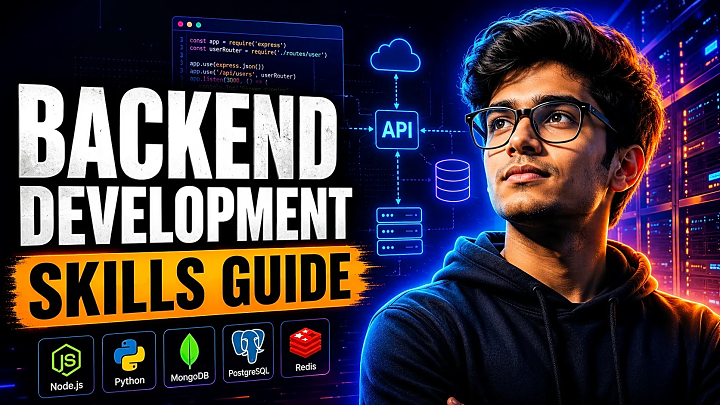
What Is Backend Development?
Backend development means building the server-side part of an application. It handles the logic that users do not directly see but depend on every time they use the system.
For example, in an online food ordering project, the frontend shows food items and buttons. The backend manages user registration, cart data, order placement, payment status, admin order updates, product records, and database changes.
A backend usually includes:
- Server-side programming
- Database connection
- APIs or routes
- Authentication and authorization
- Business logic
- Validation
- Error handling
- Reports and dashboards
- Deployment and maintenance
A simple way to understand backend flow is:
User action → frontend request → backend validation → database operation → backend response → frontend output
This flow is very useful for viva because it explains how the complete application works.
Why Backend Skills Matter for Final-Year Projects
A final-year project becomes stronger when it has working backend functionality. A static website may look good, but a project with backend logic proves that you understand real software development.
Backend skills help you explain:
- How users sign up and log in
- How data is stored in tables
- How admin and user roles are separated
- How search, filter, update, and delete features work
- How reports and dashboards are generated
- How validation prevents wrong input
- How database relationships support modules
- How the project can be tested and deployed
For academic reports, backend knowledge also supports chapters such as system design, database design, implementation, testing, output screens, and result analysis.
Core Backend Development Skills Students Should Learn
1. Choose One Backend Programming Language
Start with one backend language. Do not learn PHP, Python, Java, Node.js, and C# together in the beginning.
Good choices for students include:
|
Stack |
Best For |
Difficulty |
|
PHP + MySQL |
Simple college web projects |
Easy |
|
Python Flask |
Lightweight web apps |
Easy to medium |
|
Python Django |
Structured web apps |
Medium |
|
Node.js + Express |
MERN and API-based projects |
Medium |
|
Java + Spring Boot |
Enterprise-style systems |
Medium to hard |
Focus on variables, functions, conditions, loops, arrays, objects, classes, file handling, error handling, and folder structure.
2. Learn Database Design
Almost every serious backend project needs a database. Students should learn how to create tables, fields, primary keys, foreign keys, and relationships.
Important database skills include:
- SQL basics
- Table creation
- Insert, update, delete, and select queries
- Joins
- Search and filter queries
- Normalization
- Sample data insertion
- Backup and import
For beginner final-year projects, MySQL is one of the easiest choices. PostgreSQL is strong for structured applications, SQLite is useful for small projects, and MongoDB is useful in MERN applications.
3. Master CRUD Operations
CRUD means Create, Read, Update, and Delete. These four operations are the foundation of most backend projects.
Examples:
- Add a student record
- View all books
- Update order status
- Delete old category
- Search attendance records
- Filter leave applications
If your project has admin management, product listing, booking, inventory, reports, attendance, hospital records, or user profiles, it needs CRUD.
4. Understand REST APIs and Routes
APIs allow the frontend and backend to communicate. In modern projects, the frontend sends a request and the backend returns data, often in JSON format.
Learn:
- GET, POST, PUT, DELETE methods
- Request and response structure
- API routes
- JSON data
- Status codes
- Error messages
- API testing using Postman
Example:
|
Action |
Method |
Route |
|
View books |
GET |
/api/books |
|
Add book |
POST |
/api/books |
|
Update book |
PUT |
/api/books/:id |
|
Delete book |
DELETE |
/api/books/:id |
Even if your project is built in PHP without separate APIs, understanding routes and request flow will help you explain backend logic clearly.
5. Add Authentication and Role-Based Access
Authentication checks who the user is. Authorization checks what the user is allowed to do.
For example:
- Student can view attendance
- Teacher can mark attendance
- Admin can manage users
- Customer can place orders
- Owner can view reports
Important concepts include login, signup, logout, password hashing, sessions, JWT, protected routes, and role-based access control.
For final-year projects, at least two roles such as Admin and User make the project look more practical.
6. Learn Backend Security Basics
You do not need advanced cybersecurity knowledge for a college project, but you must know the basics.
Use this backend security checklist:
|
Security Area |
What to Do |
|
Passwords |
Never store plain-text passwords |
|
Forms |
Validate required fields |
|
Database |
Prevent SQL injection |
|
File upload |
Restrict file type and size |
|
Routes |
Protect admin pages |
|
Errors |
Do not show sensitive server errors |
|
Environment |
Do not expose database passwords publicly |
Security also improves viva answers because it shows that your project is not only functional but responsibly built.
7. Practice Testing and Debugging
Backend errors are common. A good student knows how to test and explain them.
Test these cases:
- Valid login
- Invalid password
- Empty form submission
- Duplicate email
- Unauthorized admin access
- Add/update/delete records
- Search and filter
- Report generation
- Database connection failure
In your report, include a simple test case table with test scenario, input, expected output, actual output, and result.
8. Use GitHub and Documentation
Git helps you track code changes. GitHub helps you present your project professionally.
Your backend project repository should include:
- Source code
- README file
- Setup steps
- Database file
- Screenshots
- Admin/user credentials
- Folder structure
- Module list
- API documentation, if applicable
A project without documentation is difficult to understand. A clean README improves portfolio value and helps during project submission.
9. Learn Deployment Basics
Deployment means making your project available online. Even if your college accepts a localhost demo, deployment gives you confidence.
Students should understand:
- Localhost setup
- Hosting basics
- Database hosting
- Environment variables
- Render, Railway, Vercel, Netlify, or cPanel depending on stack
- Domain and server basics
- Common production errors
A deployed backend project proves that your application can work outside your laptop.
Backend Project Module Checklist
Use this checklist before submitting your final-year project:
|
Module |
Backend Requirement |
|
Login/signup |
Authentication, password hashing, sessions/JWT |
|
Admin dashboard |
Counts, recent records, reports |
|
User profile |
View/update user data |
|
CRUD module |
Add, view, edit, delete records |
|
Search/filter |
Query database based on user input |
|
Reports |
Generate summaries, tables, PDFs, or CSVs |
|
Role access |
Separate admin/user permissions |
|
Validation |
Prevent empty, duplicate, or invalid data |
|
Testing |
Check valid and invalid cases |
|
Documentation |
README, setup guide, database import steps |
30/60/90-Day Backend Learning Roadmap
|
Timeline |
Focus Area |
Output |
|
First 30 days |
One language, database basics, CRUD |
Build one simple module |
|
Next 60 days |
Login, roles, validation, reports |
Build complete admin/user project |
|
Next 90 days |
API, deployment, GitHub, testing, viva |
Publish and document project |
Do not spend three months only watching tutorials. Build small modules every week.
Project-Wise Backend Examples
|
Project Idea |
Backend Skills Used |
|
Library Management System |
Book CRUD, issue/return, fine calculation, reports |
|
Attendance Management System |
Role login, attendance marking, monthly reports |
|
Online Food Ordering System |
Cart, order placement, payment status, admin order update |
|
Hospital Management System |
Doctor records, patient records, appointments, reports |
|
Job Portal |
Employer login, job posting, applications, status tracking |
|
College ERP |
Student, faculty, subject, attendance, marks, dashboard |
These examples help you connect backend skills with actual final-year project modules.
Advanced Backend Concepts Students Should Know
After learning the basics, understand these concepts at a simple level:
- MVC architecture for clean folder structure
- ORM for database operations through models
- Caching for faster repeated data access
- Queues for background tasks
- Logs for tracking errors
- Docker for environment consistency
- CI/CD for automated build and deployment
- API documentation using Swagger or Postman collections
You do not need to master all of these for a college project, but knowing their purpose makes your explanation stronger.
How to Explain Backend in Viva
Use this answer format:
“In my project, the user submits data through the frontend form. The backend receives the request, validates the input, checks authentication or role access, performs the database operation, and sends the response back to the frontend. For example, when an admin adds a product, the backend validates product details, stores them in the database, and displays the updated product list on the dashboard.”
This answer is simple, practical, and easy to customize for any project.
Common Backend Mistakes to Avoid
- Learning too many stacks at once
- Copying code without understanding flow
- Keeping all logic in one file
- Not using database relationships properly
- Ignoring validation
- Storing passwords as plain text
- Not testing admin/user roles
- Uploading database passwords to GitHub
- Missing setup instructions
- Building too many advanced features before core modules work
FAQ
What are the most important backend skills for beginners?
The most important backend skills are one programming language, database basics, CRUD operations, APIs, authentication, validation, testing, Git, documentation, and deployment.
Which backend stack is best for final-year students?
For simple projects, PHP + MySQL is beginner-friendly. For Python projects, Flask or Django is useful. For MERN projects, Node.js + Express + MongoDB is a good choice. For enterprise-style projects, Java + Spring Boot is strong.
Is SQL necessary for backend development?
Yes. SQL is important because most backend projects need structured data storage, search, filters, reports, and table relationships.
Can I learn backend development in 3 months?
Yes. You can learn backend basics in 3 months if you focus on one stack and build one complete project with login, CRUD, database, validation, testing, and deployment.
What backend project is best for final year?
Good backend projects include library management system, college ERP, online examination system, food ordering system, hospital management system, job portal, payroll system, and e-learning LMS.
How do I prepare backend for viva?
Prepare the request-response-database flow, database tables, login logic, CRUD modules, validation rules, test cases, and role-based access explanation.
Do backend developers need frontend skills?
Basic frontend knowledge is helpful, but backend developers mainly focus on server-side logic, database operations, APIs, authentication, security, and deployment.
Should I deploy my final-year project?
Deployment is not always compulsory, but it improves project confidence, portfolio value, and demo quality.
Conclusion
Backend development is one of the most valuable skills for final-year students because it turns a static design into a working application. Start with one language, learn database operations, build CRUD modules, add login and roles, test every feature, document the setup, and prepare a clear viva explanation.
The best strategy is simple: do not try to learn everything randomly. Build one complete project and understand every module deeply. That single project can support your college submission, viva, GitHub profile, resume, portfolio, and interview preparation.
For students who need ready-to-run backend project examples, source code, reports, database files, setup support, or demo guidance, FileMakr’s project resources can be used as practical references while learning and preparing final-year submissions.