Quick Answer: Best Frameworks for Web Development
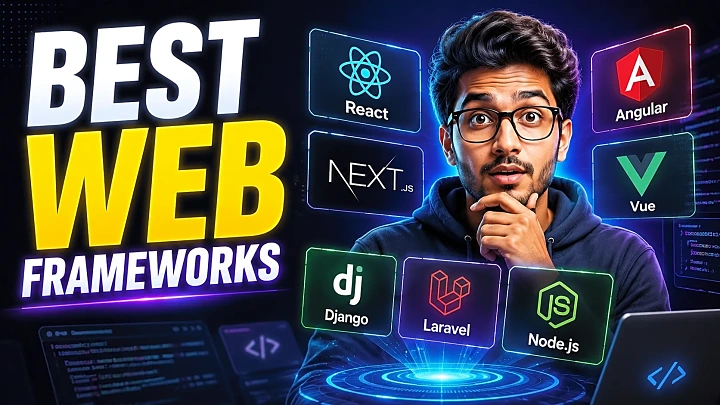
The best frameworks for web development in 2026 are React, Next.js, Angular, Vue.js, Django, Laravel, Express.js, and Spring Boot. For most final-year students, the safest choices are:
- MERN stack for modern full-stack projects
- Django for Python-based web apps and AI/ML projects
- Laravel or PHP/MySQL for database-heavy academic systems
- Next.js for SEO-friendly portfolios, blogs, and production-style apps
- Spring Boot for Java enterprise and placement-oriented projects
Need a ready-made project after choosing your stack? Explore FileMakr’s final year project source code and match your framework with a runnable project, database, and setup guidance.
How We Selected These Frameworks
This list is not based only on popularity. A student project framework should be judged by practical criteria:
|
Criteria |
Why It Matters |
|
Learning curve |
You must understand and explain the stack during viva. |
|
Documentation |
Good docs reduce setup errors and confusion. |
|
Project suitability |
The framework should match your modules and database needs. |
|
Resume value |
The stack should support internships and placement discussions. |
|
Deployment ease |
Your demo should run smoothly online or locally. |
|
Community support |
More tutorials and examples make debugging easier. |
Best Frontend Frameworks for Web Development
1. React
React is technically a UI library, but it is commonly included in frontend framework comparisons because it powers many modern web stacks. It uses reusable components, which makes it useful for dashboards, ecommerce interfaces, profile pages, admin panels, and student portals.
Choose React if: you want frontend development, MERN stack projects, or resume-friendly JavaScript skills.
Avoid React if: you do not yet understand JavaScript fundamentals, components, state, and props.
Best project ideas: ecommerce frontend, student dashboard, task manager, social networking platform, learning management system.
For MERN-based ideas, connect this section to MERN stack projects with source code.
2. Next.js
Next.js is built on React and adds routing, server-side rendering, API routes, static generation, and better SEO support. If React is good for interactive interfaces, Next.js is better for production-style websites.
Choose Next.js if: your project needs SEO-friendly pages, blogs, portfolios, SaaS-style dashboards, or fast loading.
Avoid Next.js if: you have not learned React basics yet.
Best project ideas: portfolio website, blog platform, ecommerce store, job portal, SaaS dashboard.
3. Angular
Angular is a structured frontend framework that uses TypeScript and is suitable for large applications. It may feel difficult for beginners, but it teaches enterprise-level architecture.
Choose Angular if: you want disciplined frontend structure and corporate-style projects.
Avoid Angular if: your deadline is short or you are not comfortable with TypeScript.
Best project ideas: ERP dashboard, admin panel, banking-style UI, inventory system.
4. Vue.js
Vue.js is beginner-friendly, flexible, and easier to start with than Angular. It works well for small to medium applications where clean UI and fast development matter.
Choose Vue if: you want a smooth learning curve and simple frontend development.
Avoid Vue if: your college or target companies mainly expect React or Angular.
Best project ideas: portfolio, lightweight dashboard, event management system, simple CRM.
Best Backend Frameworks for Web Development
5. Django
Django is a Python web framework designed for fast and secure development. It includes useful built-in features like admin panel, authentication, ORM, forms, and database handling.
For final-year students, Django is one of the strongest choices because it supports complete academic projects with clear modules and documentation.
Choose Django if: you know Python or your project involves AI, ML, data analysis, admin panels, or management systems.
Avoid Django if: you only need a tiny API and want a very lightweight backend.
Best project ideas: college management system, AI/ML prediction app, blog system, attendance system, hospital management system.
Link this section to Django Python projects.
6. Laravel
Laravel is a PHP web application framework with MVC architecture, routing, authentication, database migrations, Blade templates, and clean backend structure.
Laravel is useful for students whose colleges prefer PHP and MySQL projects but still expect a modern framework-based approach.
Choose Laravel if: you want PHP/MySQL, admin panels, reports, role-based login, and database-heavy systems.
Avoid Laravel if: your career target is mainly JavaScript full-stack or Python development.
Best project ideas: complaint management system, online booking system, college ERP, inventory management, expense tracker.
Link this section to PHP projects with MySQL.
7. Express.js
Express.js is a minimal Node.js backend framework used for APIs and server-side logic. It is commonly used in the MERN stack with MongoDB, React, and Node.js.
Choose Express if: you want full-stack JavaScript, REST APIs, JWT login, middleware, and React backend integration.
Avoid Express if: you want many built-in backend features without configuring them yourself.
Best project ideas: chat app, ecommerce API, task manager, job portal, social media app.
8. Spring Boot
Spring Boot is a Java framework used for production-grade, enterprise-style backend applications. It is more advanced than Django or Laravel for beginners, but valuable for students targeting Java developer roles.
Choose Spring Boot if: you are strong in Java and want enterprise backend learning.
Avoid Spring Boot if: your deadline is short or you need a simple beginner project.
Best project ideas: banking system, insurance portal, enterprise dashboard, REST API backend.
Framework Comparison Table
|
Framework |
Type |
Best For |
Difficulty |
Student Fit |
|
React |
Frontend/library |
UI, dashboards, MERN |
Medium |
Excellent |
|
Next.js |
Full-stack React |
SEO-friendly apps |
Medium-high |
Excellent after React |
|
Angular |
Frontend |
Enterprise apps |
High |
Good for corporate roles |
|
Vue.js |
Frontend |
Beginner UI projects |
Low-medium |
Good |
|
Django |
Backend |
Python apps, admin panels |
Medium |
Excellent |
|
Laravel |
Backend |
PHP/MySQL projects |
Medium |
Excellent |
|
Express.js |
Backend |
APIs, MERN stack |
Medium |
Excellent |
|
Spring Boot |
Backend |
Java enterprise apps |
High |
Good for Java students |
Best Framework by Project Type
|
Project Type |
Recommended Framework |
Why |
|
Ecommerce website |
Next.js, Laravel, Django |
SEO, product pages, admin, orders |
|
Chat application |
MERN stack |
React UI, Express APIs, Socket.IO |
|
College ERP |
Laravel, Django, Spring Boot |
User roles, reports, database modules |
|
AI/ML web app |
Django, FastAPI |
Python ecosystem support |
|
Portfolio/blog |
Next.js, Astro |
SEO-friendly and fast |
|
Admin dashboard |
React, Angular |
Component-based UI |
|
PHP academic system |
Laravel/PHP |
MySQL, admin panel, CRUD |
Honorable Mentions
Some frameworks are worth knowing even if they are not the safest first choice for most students.
- FastAPI: excellent for Python APIs and AI/ML backends.
- Flask: lightweight Python framework for small projects.
- Nuxt.js: Vue-based full-stack framework.
- SvelteKit: modern full-stack framework with strong performance.
- Astro: great for fast content-driven websites.
- Ruby on Rails: productive full-stack framework, but less common in many Indian college project ecosystems.
- ASP.NET Core: strong for Microsoft and C# enterprise development.
Implementation Guide: How to Choose Your Framework
Step 1: Define your project type.
Is it ecommerce, ERP, chat, AI/ML, dashboard, booking, or portfolio?
Step 2: Match the stack.
Use React or Next.js for UI-heavy projects, Django for Python projects, Laravel for PHP/MySQL systems, Express for MERN APIs, and Spring Boot for Java enterprise backends.
Step 3: Check your deadline.
For short deadlines, avoid overly complex stacks. Django, Laravel, and ready MERN templates can save time.
Step 4: Plan core modules.
Most final-year projects need login, registration, admin panel, user dashboard, CRUD, search, filters, reports, and database tables.
Step 5: Prepare documentation early.
Start your synopsis, SRS, ER diagram, DFD, UML diagram, test cases, screenshots, and final-year project report while building the project.
Step 6: Test your demo.
Check login, database connection, admin operations, user flow, form validation, and deployment before viva.
Step 7: Add resume value.
Mention your framework, database, APIs, authentication, deployment, GitHub link, and live demo.
Common Mistakes Students Make
- Choosing a framework only because it is trending
- Starting Next.js before understanding React
- Choosing Angular without TypeScript basics
- Using Express without understanding REST APIs
- Ignoring database design
- Copying source code without understanding modules
- Not preparing project documentation
- Building too many features and missing core functionality
- Testing only on the final viva day
FAQs
Which framework is best for web development beginners?
React, Vue.js, Django, and Laravel are good beginner-friendly options. React is strong for frontend careers, Django is best for Python students, and Laravel is useful for PHP/MySQL projects.
Which framework is best for final-year projects?
MERN stack, Django, and Laravel are the safest choices for most final-year projects because they support frontend, backend, database, login, admin panel, and documentation needs.
Is React a framework or library?
React is technically a JavaScript library for building user interfaces, but it is commonly included in framework comparisons because it is widely used in modern frontend and full-stack development.
Should I learn React or Next.js first?
Learn React first. Once you understand components, props, state, and routing basics, move to Next.js for SEO-friendly and production-style applications.
Is Django better than Express.js?
Django is better when you want built-in admin, ORM, authentication, and Python support. Express.js is better when you want a lightweight JavaScript API backend for MERN stack projects.
Is Django better than Laravel?
Django is better for Python-based projects and AI/ML integration. Laravel is better for PHP/MySQL academic systems and MVC-style database projects.
Which framework is best for AI/ML web projects?
Django and FastAPI are strong choices because they work well with Python-based machine learning libraries and API workflows.
Which framework is best for placement?
React, Node.js, Express.js, Django, Laravel, and Spring Boot are placement-friendly. For full-stack roles, React with Node.js or MERN stack is especially useful.
Conclusion
The best framework for web development depends on your project goal, skill level, deadline, and career target.
Choose MERN stack if you want a modern full-stack JavaScript project. Choose Django if you prefer Python and want strong backend structure. Choose Laravel if your college expects PHP and MySQL. Choose Next.js if you want a professional SEO-friendly web app. Choose Spring Boot if you are serious about Java enterprise roles.
Do not choose a framework only because it is trending. Choose the one you can build, explain, document, test, and present confidently.
Need a ready-to-run final-year project? Explore FileMakr’s source code, project reports, and framework-based project categories to save time and prepare a stronger viva-ready submission.