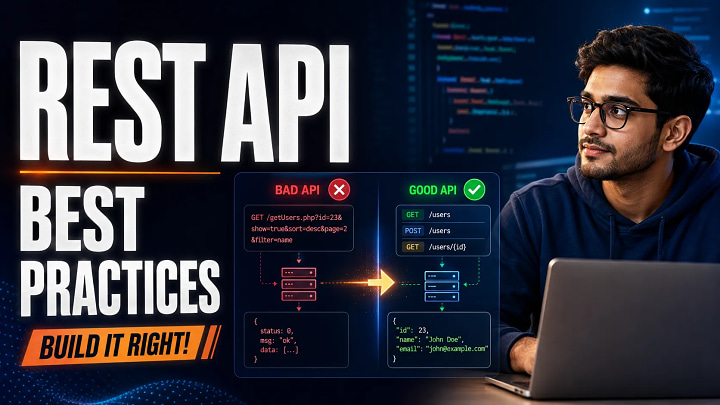
REST API Design Best Practices: Student Guide with Examples
A backend can work and still be frustrating to use. One endpoint returns user_name, another returns username, and a third calls the same field name. Some routes use nouns, others use verbs, and every error follows a different JSON structure.
The frontend then becomes full of endpoint-specific conditions. Postman collections become difficult to maintain. Documentation stops matching the code.
REST API design best practices prevent this problem by creating a predictable contract between clients and servers.
Quick Answer: What Are the Best REST API Design Practices?
Design APIs around domain resources, use consistent noun-based endpoints, apply HTTP methods and status codes correctly, validate inputs, standardize success and error responses, enforce object-level authorization, paginate collections, support safe retries, use caching deliberately, plan backward-compatible changes, document the contract with OpenAPI, and test the API from a consumer’s perspective.
What Is API Design?
API design defines how software consumers interact with a service: its resources, endpoints, methods, parameters, request bodies, response schemas, errors, authentication rules, compatibility policy, and documentation.
This guide focuses on RESTful HTTP APIs used in web, mobile, and final-year software projects. GraphQL, gRPC, WebSocket, and event-driven APIs follow different conventions.
1. Design Around Domain Resources
Start with business concepts, not database tables. For a Student Management System, resources may include students, courses, enrollments, attendance records, and results.
|
Requirement |
Better Endpoint |
Avoid |
|
List students |
GET /api/v1/students |
GET /getStudentMasterData |
|
Get one student |
GET /api/v1/students/42 |
GET /student.php?id=42 |
|
View attendance |
GET /api/v1/students/42/attendance |
GET /attendance_table?student_id=42 |
|
Create enrollment |
POST /api/v1/enrollments |
POST /addCourseToStudent |
Resource-oriented design keeps the API aligned with the consumer’s mental model and hides internal implementation details. Microsoft’s API design guidance similarly recommends nouns for resource names because HTTP methods already expre
Students studying application architecture can connect this principle with FileMakr’s software design patterns for final-year projects.
2. Use Consistent Endpoint Naming
Use plural nouns for collections:
/students
/courses
/enrollments
/projects
Use path parameters to identify a resource and query parameters to refine a collection:
GET /api/v1/students/42
GET /api/v1/students?department=cse&year=4
Avoid mixing /getStudents, /student-list, and /fetch_all_students. Keep nesting shallow; deeply nested paths become difficult to understand and evolve.
Consistency has a measurable usability benefit. Recent industry research identified adherence to conventions as one of the most important factors affecting REST
3. Use HTTP Methods and Status Codes Correctly
|
Operation |
Method |
Example |
Success |
|
Read collection |
GET |
/students |
200 OK |
|
Create resource |
POST |
/students |
201 Created |
|
Replace resource |
PUT |
/students/42 |
200 or 204 |
|
Partially update |
PATCH |
/students/42 |
200 or 204 |
|
Delete resource |
DELETE |
/students/42 |
204 No Content |
GET must not change server state. PUT and DELETE are idempotent in HTTP semantics: repeating the same intended request should have the same intended server effect.
Use common status codes consistently:
- 400 Bad Request for malformed input or a documented general validation policy
- 401 Unauthorized when valid authentication credentials are missing
- 403 Forbidden when the server refuses to authorize the request
- 404 Not Found when a resource does not exist
- 409 Conflict for duplicate or state-conflict conditions
- 422 Unprocessable Content when the API distinguishes semantic validation errors
- 429 Too Many Requests when a rate limit is exceeded
Do not treat 400 versus 422 as a universal rule. Either can be reasonable when documented and consistent.
4. Standardize Responses and Errors
Clients should not guess whether data appears under result, payload, or item.
{
"data": {
"id": 42,
"name": "Aarav Sharma",
"department": "CSE"
}
}
For errors, use a stable machine-readable format:
Content-Type: application/problem+json
{
"type": "https://www.filemakr.com/problems/validation-error",
"title": "Validation failed",
"status": 422,
"detail": "One or more fields are invalid.",
"errors": [
{
"field": "email",
"message": "Enter a valid email address."
}
]
}
RFC 9457 defines problem details as a reusable way to carry machine-readable error information without inventing an unrelated error format for e
Keep error types stable so clients can react programmatically. Never expose stack traces, SQL queries, server paths, tokens, or secret keys.
5. Choose the Right Pagination Strategy
Never return an unlimited collection.
GET /students?page=2&limit=20&department=cse&sort=-created_at
For large or frequently changing datasets, use a cursor:
GET /students?cursor=eyJpZCI6NDJ9&limit=20
|
Strategy |
Best For |
Limitation |
|
Page or offset |
Admin tables and small datasets |
Records can shift between pages |
|
Cursor |
Large, changing collections |
Harder to jump to page numbers |
Define a default sort order, maximum page size, and stable tie-breaker to prevent skipped or duplicated records.
6. Secure Authentication and Authorization
Authentication answers, “Who is making the request?” Authorization answers, “What may that identity access?”
Every endpoint that accepts an object ID must verify access to that object. A logged-in student should not be able to edit /students/43 by replacing their own ID.
Use HTTPS, server-side authorization, input validation, secure credential handling, rate limiting, restricted response fields, dependency updates, and audit logging.
Role checks alone are insufficient. Also check ownership, tenant, record status, and permitted fields. OWASP identifies broken object-level authorization, broken authentication, object-property authorization and unrestricted resource consumption among ma
FileMakr’s guide to authentication and authorization for web applications provides additional guidance on sessions, JWT, OAuth, MFA and role-based access.
7. Support Idempotency and Safe Retries
A client may submit a request, lose the response, and retry without knowing whether the first request succeeded.
For payments, bookings, orders, or other duplicate-sensitive operations, accept an idempotency key:
POST /api/v1/payments
Idempotency-Key: 9c78b20f-...
The server stores the key with the original result and returns the same outcome when the request is repeated. This prevents a temporary network failure from creating duplicate payments or bookings.
8. Use Caching and Conditional Requests
Caching reduces latency and server work when applied deliberately.
Cache-Control: private, max-age=60
ETag: "student-42-v3"
A client can later send:
If-None-Match: "student-42-v3"
When the representation is unchanged, the server can return 304 Not Modified without sending the full body.
Do not publicly cache sensitive or user-specific data. Define cache behavior as part of the API contract rather than relying on accidental framework defaults.
9. Plan Versioning and Compatibility
Adding an optional field is usually safer than renaming or removing one. Risky changes include changing data types, deleting accepted values, or altering error behavior.
A simple student-project strategy is:
/api/v1/students
Do not create a new version for every minor change. Introduce a new major version only for unavoidable incompatibilities, then provide migration guidance and a deprecation timeline.
Compatibility should be considered throughout the API lifecycle rather than only when a breaking change is ready for release. Google’s API guidance treats backward compatibility and versioning as distinct de
10. Define the Contract with OpenAPI
An API-first workflow defines the contract before all controllers and database logic are completed.
paths:
/api/v1/students/{studentId}:
get:
summary: Retrieve a student
parameters:
- in: path
name: studentId
required: true
schema:
type: integer
responses:
"200":
description: Student found
"404":
description: Student not found
The OpenAPI Specification provides a language-agnostic description for HTTP APIs that humans and software tools can understand without inspecting the service’
Use the contract to generate documentation, create mocks, validate schemas, lint conventions, and detect breaking changes in continuous integration.
Students moving from design to code can follow FileMakr’s guide on how to build a REST API for student projects.
Worked Example: Student Enrollment API
Request
POST /api/v1/enrollments
Authorization: Bearer <token>
Content-Type: application/json
Idempotency-Key: enrollment-42-CSE401
{
"student_id": 42,
"course_id": "CSE401"
}
Successful response
201 Created
Location: /api/v1/enrollments/9001
{
"data": {
"id": 9001,
"student_id": 42,
"course_id": "CSE401",
"status": "active"
}
}
Return 409 Conflict for a duplicate active enrollment and 403 Forbidden when the caller cannot manage the student. Validate both related resources, document every outcome in OpenAPI, and test success, invalid input, unauthorized access, duplication, and retry behavior.
This one workflow demonstrates how resource naming, HTTP status codes, authorization, validation and idempotency work together.
REST API Design Checklist
Before publishing or demonstrating the API, confirm that:
- resources and endpoint names are consistent
- methods, status codes, success bodies and errors are defined
- collections have limits and stable sorting
- protected objects have ownership or role checks
- OpenAPI matches the implementation
- tests include failure paths
- logs include a request or correlation ID
- metrics track latency, errors and endpoint usage
Common REST API Design Mistakes
Common mistakes include exposing database names, using verbs in every URL, mixing naming styles, returning 200 OK for failures, allowing unlimited collections, trusting object IDs without authorization, leaking internal errors, breaking clients without warning, and documenting only after development.
For a final-year project, five consistent, secure, documented endpoints are more impressive than twenty inconsistent ones.
Frequently Asked Questions
How do you design a REST API?
Identify consumers and use cases, model domain resources, define endpoints and schemas, assign methods and status codes, design authorization rules, document the contract with OpenAPI, and test it from the client’s perspective.
Should REST endpoints use nouns or verbs?
Use nouns for normal resources, such as /students or /orders. HTTP methods express standard actions. Use custom action endpoints only when an operation cannot be modeled clearly as a resource.
What is idempotency in API design?
Idempotency means repeating the same intended request has the same intended server effect. It is important for safe retries involving updates, payments, orders and bookings.
Should an API use offset or cursor pagination?
Use offset or page pagination for simple tables and smaller datasets. Use cursor pagination for large or rapidly changing collections.
What should an API error response contain?
Include an appropriate status code, stable machine-readable type, short title, useful detail and field-level validation information when needed.
Why should students use OpenAPI or Swagger?
OpenAPI makes the contract reviewable and machine-readable. Swagger tools can render interactive documentation, while other tools can generate mocks, validation, tests and client code.
Conclusion
Good REST API design turns backend logic into a dependable product interface. Start with domain resources, consistent naming, correct HTTP behavior, standard errors, strong authorization, bounded collections, safe retries, caching rules, compatibility planning and an OpenAPI contract.
For a final-year project, review the API contract before writing every controller. It will improve frontend integration, Postman testing, documentation, architecture diagrams and viva explanations.
Ready to move from design to implementation? Explore FileMakr’s Node.js projects with source code or test a working project demo before selecting your project.
This version deliberately prioritizes a connected implementation example over adding more disconnected rules.