Waste Management System Using IoT: ESP32 Project Guide for Final-Year Students
Quick Answer
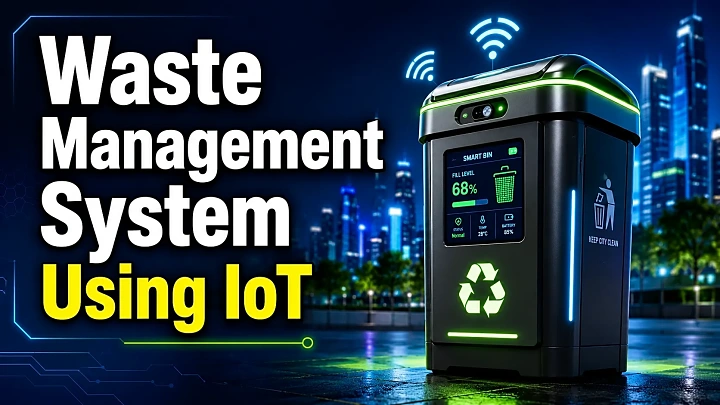
A Waste Management System Using IoT is a smart garbage monitoring project that uses sensors, an ESP32 or NodeMCU, and a cloud dashboard to track dustbin fill level in real time. When the bin becomes full, the system sends alerts so collection staff can empty it before overflow.
Introduction
Overflowing dustbins, delayed garbage collection, bad odor, and manual monitoring are common problems in cities, campuses, apartments, hospitals, and public places. A Waste Management System Using IoT solves this problem by connecting dustbins to the internet and monitoring waste levels automatically.
For final-year students, this is a strong project because it combines embedded systems, IoT sensors, cloud dashboards, alert notifications, and smart-city applications. It is also relevant in India, where official PIB data reported that urban India processed 1,29,206.87 TPD of solid waste out of 1,59,109.02 TPD generated in 2025.
Waste Management System Using IoT Project Abstract
The proposed IoT-based waste management system monitors garbage bin levels using an ultrasonic sensor connected to an ESP32 microcontroller. The sensor measures the distance between the bin lid and garbage level. The ESP32 calculates the fill percentage and sends real-time data to a dashboard such as Blynk, Firebase, ThingSpeak, or a custom web application.
When the bin reaches a predefined threshold, such as 80%, the system triggers an alert. This helps reduce bin overflow, improves collection planning, and supports smarter sanitation monitoring.
Objectives of the Project
The main objectives are:
- To monitor garbage bin fill level in real time.
- To reduce manual dustbin inspection.
- To send alerts when the bin is full.
- To display bin status on a dashboard.
- To improve waste collection efficiency.
- To support smart-city and campus sanitation systems.
- To provide project-report-ready implementation for students.
What Is an IoT-Based Waste Management System?
An IoT-based waste management system is a smart garbage monitoring solution that uses sensors and internet connectivity to track dustbin status. Instead of checking bins manually, sanitation teams can view real-time data from a dashboard.
A smart waste bin can monitor:
- Fill level
- Waste weight
- Bad odor or gas level
- Lid status
- Wet/dry waste category
- Collection status
- Location-wise bin condition
A basic final-year version usually uses ESP32 + HC-SR04 ultrasonic sensor + dashboard alert system. The ESP32 is suitable because it supports Wi-Fi and Bluetooth connectivity for IoT applications.
Existing System vs Proposed System
|
Factor |
Existing Manual System |
Proposed IoT-Based System |
|
Monitoring |
Manual inspection |
Real-time sensor monitoring |
|
Collection |
Fixed schedule |
Need-based collection |
|
Overflow risk |
High |
Reduced with alerts |
|
Data tracking |
Not available |
Dashboard and history |
|
Efficiency |
Low |
Higher |
|
Cost control |
Poor route planning |
Better collection planning |
|
Smart-city use |
Limited |
Suitable for smart-city deployment |
Components Required
|
Component |
Purpose |
Recommended Option |
|
Microcontroller |
Reads sensor data and sends it online |
ESP32 / NodeMCU |
|
Ultrasonic Sensor |
Measures garbage fill level |
HC-SR04 |
|
Load Cell |
Measures waste weight |
HX711 + Load Cell |
|
Gas Sensor |
Detects odor or harmful gases |
MQ-135 |
|
Servo Motor |
Opens/closes smart lid |
SG90 |
|
Display |
Shows local status |
OLED / LCD |
|
Dashboard |
Displays live data |
Blynk / Firebase / ThingSpeak |
|
Alert Device |
Local warning |
Buzzer / LED |
|
Power Supply |
Powers circuit |
5V adapter or battery |
Best beginner setup: ESP32 + HC-SR04 ultrasonic sensor + buzzer + Blynk dashboard.
Circuit Diagram and ESP32 Pin Connections
For a basic smart dustbin using ESP32 and ultrasonic sensor, use the following wiring:
|
Device Pin |
ESP32 Pin |
Purpose |
|
HC-SR04 VCC |
5V |
Sensor power |
|
HC-SR04 GND |
GND |
Ground |
|
HC-SR04 Trig |
GPIO 5 |
Trigger pulse |
|
HC-SR04 Echo |
GPIO 18 |
Distance reading |
|
Buzzer + |
GPIO 23 |
Full-bin alert |
|
Buzzer - |
GND |
Ground |
|
OLED SDA |
GPIO 21 |
Display data |
|
OLED SCL |
GPIO 22 |
Display clock |
Important: Use voltage protection for the HC-SR04 Echo pin if required, because some ultrasonic modules output 5V logic while ESP32 GPIO pins are 3.3V tolerant.
How the Waste Management System Using IoT Works
The working process is simple:
- The ultrasonic sensor is mounted at the top of the dustbin.
- It measures the empty distance between the sensor and garbage level.
- ESP32 calculates the garbage fill percentage.
- The value is displayed on OLED or LCD.
- ESP32 sends the data to a cloud dashboard.
- If the fill level crosses 80%, the system triggers a buzzer and sends an alert.
- Collection staff empty only the bins that need attention.
Fill-Level Formula
Fill Percentage = ((Bin Height - Measured Distance) / Bin Height) × 100
Example:
If bin height is 40 cm and measured empty space is 10 cm:
Fill Percentage = ((40 - 10) / 40) × 100 = 75%
Recommended System Architecture
A strong final-year project should include four layers:
1. Sensor Layer
This layer collects data using ultrasonic sensors, load cells, gas sensors, or moisture sensors.
2. Controller Layer
ESP32 or NodeMCU processes sensor readings, calculates fill level, and controls buzzer alerts.
3. Communication Layer
The controller sends data using Wi-Fi, GSM, LoRa, or MQTT depending on the project scope.
4. Application Layer
The dashboard shows bin ID, location, fill percentage, alert status, last updated time, and collection status.
Dashboard Options for IoT Waste Management
|
Platform |
Best For |
Limitation |
|
Blynk |
Fast mobile dashboard |
Limited customization |
|
Firebase |
Real-time web/mobile app |
Needs setup knowledge |
|
ThingSpeak |
Simple IoT graphs |
Basic interface |
|
ThingsBoard |
MQTT and advanced dashboards |
More complex |
|
Custom Web App |
Best final-year major project |
Requires backend coding |
Firebase is useful when the project needs real-time sync across web or mobile clients.
Waste Management System Using IoT Source Code Flow
Use this logic in your ESP32 source code:
Start
Connect ESP32 to Wi-Fi
Initialize ultrasonic sensor
Set bin height
Measure distance
Calculate fill percentage
Display fill level
Upload data to dashboard
If fill level >= 80%:
Turn ON buzzer
Send alert notification
Else:
Keep buzzer OFF
Repeat after fixed interval
For better marks, add error handling for Wi-Fi disconnection, invalid sensor readings, and dashboard update failure.
Implementation Guide
Step 1: Define Project Scope
Decide whether the system will monitor one bin, multiple bins, or include wet/dry waste segregation. For most students, one smart bin with dashboard monitoring is enough.
Step 2: Select Hardware
Use ESP32, HC-SR04 ultrasonic sensor, buzzer, LED, OLED display, jumper wires, breadboard, and 5V power supply.
Step 3: Build the Circuit
Mount the ultrasonic sensor at the top center of the bin. Keep the sensor straight to avoid incorrect readings.
Step 4: Configure Dashboard
Create dashboard fields for:
- Bin ID
- Location
- Fill percentage
- Alert status
- Last updated time
- Collection status
- Graph history
Step 5: Test the System
Test the bin at different levels: empty, 25%, 50%, 75%, and full.
Sample Testing Table
|
Test Case |
Expected Result |
Status |
|
Empty bin |
Dashboard shows 0–10% |
Pass |
|
Half-filled bin |
Dashboard shows around 50% |
Pass |
|
Full bin |
Alert triggers above threshold |
Pass |
|
Wi-Fi disconnect |
ESP32 retries connection |
Pass |
|
Dashboard update |
Data refreshes regularly |
Pass |
|
Buzzer alert |
Buzzer turns on when bin is full |
Pass |
Estimated Cost of IoT Smart Dustbin Project
|
Component |
Approx. Cost Range |
|
ESP32 |
₹350–₹600 |
|
HC-SR04 Sensor |
₹80–₹150 |
|
Buzzer + LED |
₹30–₹80 |
|
Jumper Wires |
₹50–₹100 |
|
OLED/LCD Display |
₹150–₹300 |
|
Dustbin Prototype |
₹100–₹300 |
|
Power Supply |
₹150–₹300 |
|
Total Basic Cost |
₹900–₹1,800 approx. |
Advantages and Limitations
|
Advantages |
Limitations |
|
Reduces manual checking |
Sensor may give wrong readings if placed incorrectly |
|
Prevents bin overflow |
Wi-Fi dependency in basic models |
|
Supports smart-city systems |
Needs stable power supply |
|
Improves collection planning |
Wet waste can affect sensor accuracy |
|
Provides real-time dashboard |
Requires calibration |
Applications
A Waste Management System Using IoT can be used in:
- Smart cities
- Colleges and universities
- Apartment societies
- Hospitals
- Railway stations
- Shopping malls
- Industrial campuses
- Municipal waste collection systems
Common Mistakes to Avoid
- Placing the ultrasonic sensor at an angle.
- Not calibrating bin height.
- Using Arduino UNO without a Wi-Fi module.
- Sending dashboard updates too frequently.
- Ignoring Wi-Fi reconnection logic.
- Not adding screenshots in the project report.
- Explaining only hardware and ignoring software modules.
Project Report Format
Use this structure in your final-year report:
- Abstract
- Introduction
- Existing System
- Proposed System
- Objectives
- Hardware Requirements
- Software Requirements
- Block Diagram
- Circuit Diagram
- Methodology
- Source Code Flow
- Testing
- Results
- Advantages
- Limitations
- Applications
- Future Scope
- Conclusion
Future Scope
Future improvements include:
- Wet and dry waste segregation
- GPS-based bin tracking
- Solar-powered smart bins
- AI-based fill-level prediction
- Route optimization for collection vehicles
- Multi-bin monitoring dashboard
- Mobile app for collection staff
FAQ
1. What is a Waste Management System Using IoT?
It is a smart system that uses sensors and internet-connected controllers to monitor garbage bin levels and send alerts when bins are full.
2. Which sensor is used in a smart dustbin?
The HC-SR04 ultrasonic sensor is commonly used because it measures the distance between the sensor and the garbage level.
3. Which microcontroller is best for IoT waste management?
ESP32 is usually best because it has built-in Wi-Fi, enough GPIO pins, and strong IoT support.
4. Can this project use Arduino?
Yes. Arduino can be used for a basic smart dustbin, but for IoT features, ESP32 or NodeMCU is better.
5. What is the cost of an IoT smart dustbin project?
A basic prototype usually costs around ₹900–₹1,800 depending on components and dashboard features.
6. What dashboard can be used?
You can use Blynk, Firebase, ThingSpeak, ThingsBoard, or a custom web dashboard.
7. Is source code required for this project?
Yes. Source code is required to read sensor values, calculate fill percentage, connect to Wi-Fi, update the dashboard, and trigger alerts.
8. What are the limitations of this project?
The main limitations are sensor accuracy, Wi-Fi dependency, power supply stability, and calibration errors.
Conclusion
A Waste Management System Using IoT is a practical and high-value final-year project because it solves a real sanitation problem using sensors, ESP32, dashboards, and real-time alerts. It demonstrates IoT architecture, embedded programming, cloud communication, project testing, and smart-city use cases.
For best academic results, include a proper abstract, circuit diagram, pin table, source-code flow, dashboard screenshots, test readings, advantages, limitations, and future scope.
Need a ready project report, documentation, or source-code structure? Explore FileMakr’s final-year project resources and related IoT project guides.