Concrete Crack Detection Using Machine Learning | Source Code
LIMITED TIME
Get Source Code ₹99
• Source Code

Concrete Crack Detection Using Machine Learning Source Code ( Final Year)

Download clean, well-commented Concrete Crack Detection Using Machine Learning source code for final year projects — easy to run, demo-ready, and mentor-friendly.

  • MACHINE-LEARNING Project
  • MySQL / MongoDB
  • Setup guide & demo steps
  • Beginner-friendly

Keywords: source code, final year project code, Concrete Crack Detection Using Machine Learning Git, documentation, installation guide, machine-learning project, college project demo.

Download Source Code

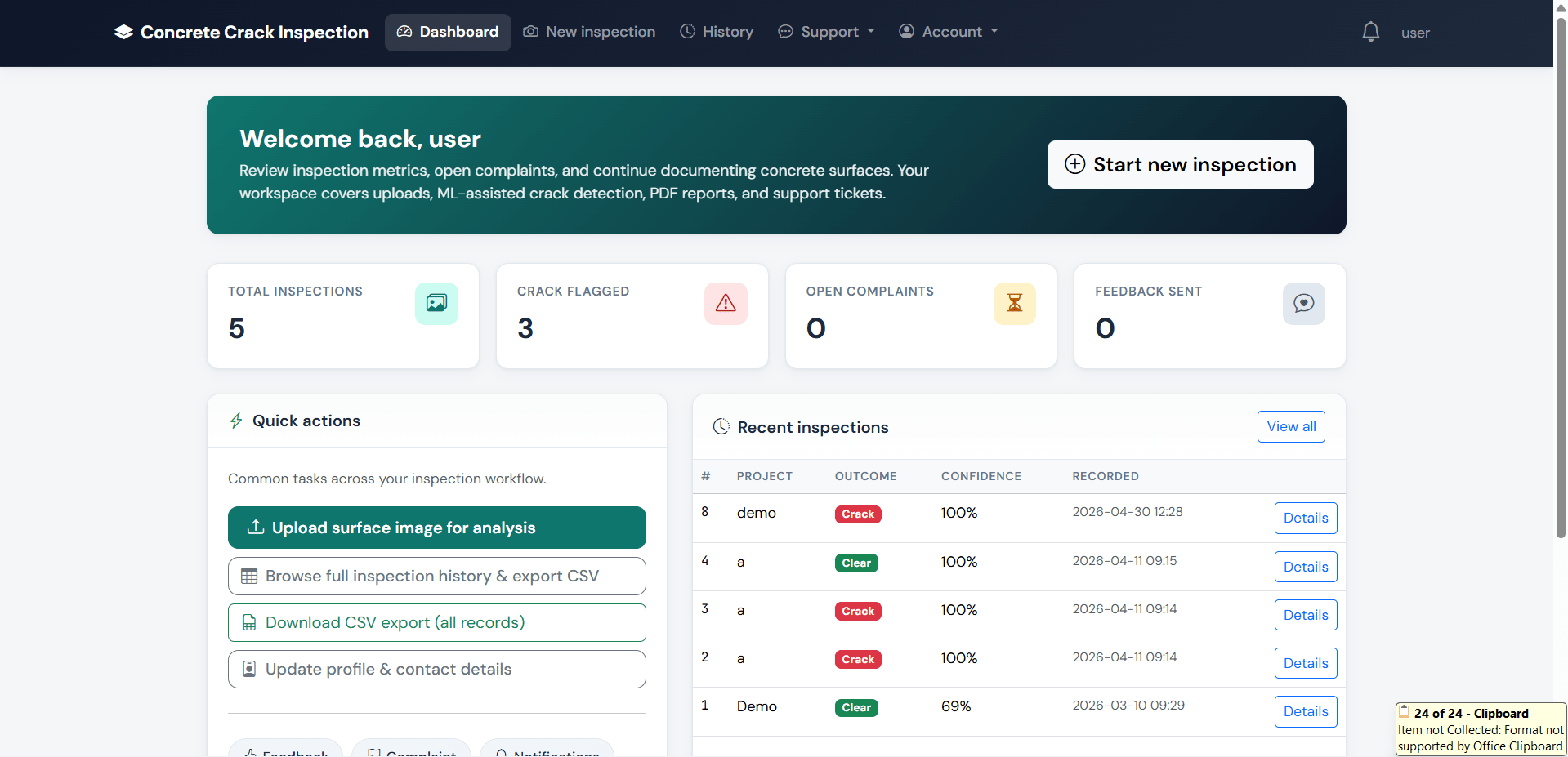
Admin Features

1. Data Preprocessing and Augmentation:

  • Bilateral Filtering: Reduces salt and pepper noise while preserving image edges, crucial for accurate crack detection.
  • Morphological Operations: Removes small noise while maintaining significant image features, enhancing crack visibility.
  • Grayscaling:Converts images to grayscale, reducing computational complexity and processing time without losing essential information.
  • Data Augmentation: Techniques like rotation, flipping, and brightness adjustment increased the dataset size from 300 to 3000 images per class, improving model robustness.

2. Modeling:

  • Transfer Learning with ResNet and VGG16: Both architectures were evaluated for performance in crack detection. ResNet was chosen as the final model due to its superior accuracy.
  • High Accuracy: The final model achieved a perfect F1 score of 1, demonstrating flawless classification of cracked and non-cracked surfaces.

3. Methodology:

  • Data Exploration: Manual analysis to identify noise and select appropriate preprocessing techniques.
  • Image Processing: Application of Bilateral Filtering and Morphological Operations to optimize image quality for model training.
  • Model Training and Evaluation: Extensive evaluation of ResNet and VGG16 models to select the best-performing architecture for final deployment.

4. Dataset:

  • The dataset used for training and testing is publicly available on Kaggle, facilitating further research and development in concrete crack detection.
Description

This project leverages computer vision and machine learning techniques to automate the process of detecting cracks in concrete structures. The primary goal is to provide an efficient and accurate method for damage surveillance in buildings, which is crucial for maintaining structural integrity and safety. The project was developed as an entry for the "PS-1, Concrete Crack Detection". The model has achieved an impressive F1 score of 1, indicating its high accuracy in distinguishing between cracked and non-cracked surfaces.


The Concrete Crack Detection Using Machine Learning final-year Concrete Crack Detection Using Machine Learning source code is structured for fast setup and easy customization. You get readable code, clear folder architecture, and a guided README so you can run locally and present confidently.

Source Code Overview
Technical snapshot & environment
Project Name
Concrete Crack Detection Using Machine Learning
Language / Stack
machine-learning
Database
MySQL or MongoDB
Browsers
Chrome, Firefox, Edge, Opera
Included in the download
Frontend,Backend,Database
Run Scripts
Documented in README (install, seed, start)
License
Academic use for college submission
Academic use only: this code is provided to help you learn and submit your college project. For institute-specific formatting or extra diagrams, contact us on WhatsApp.
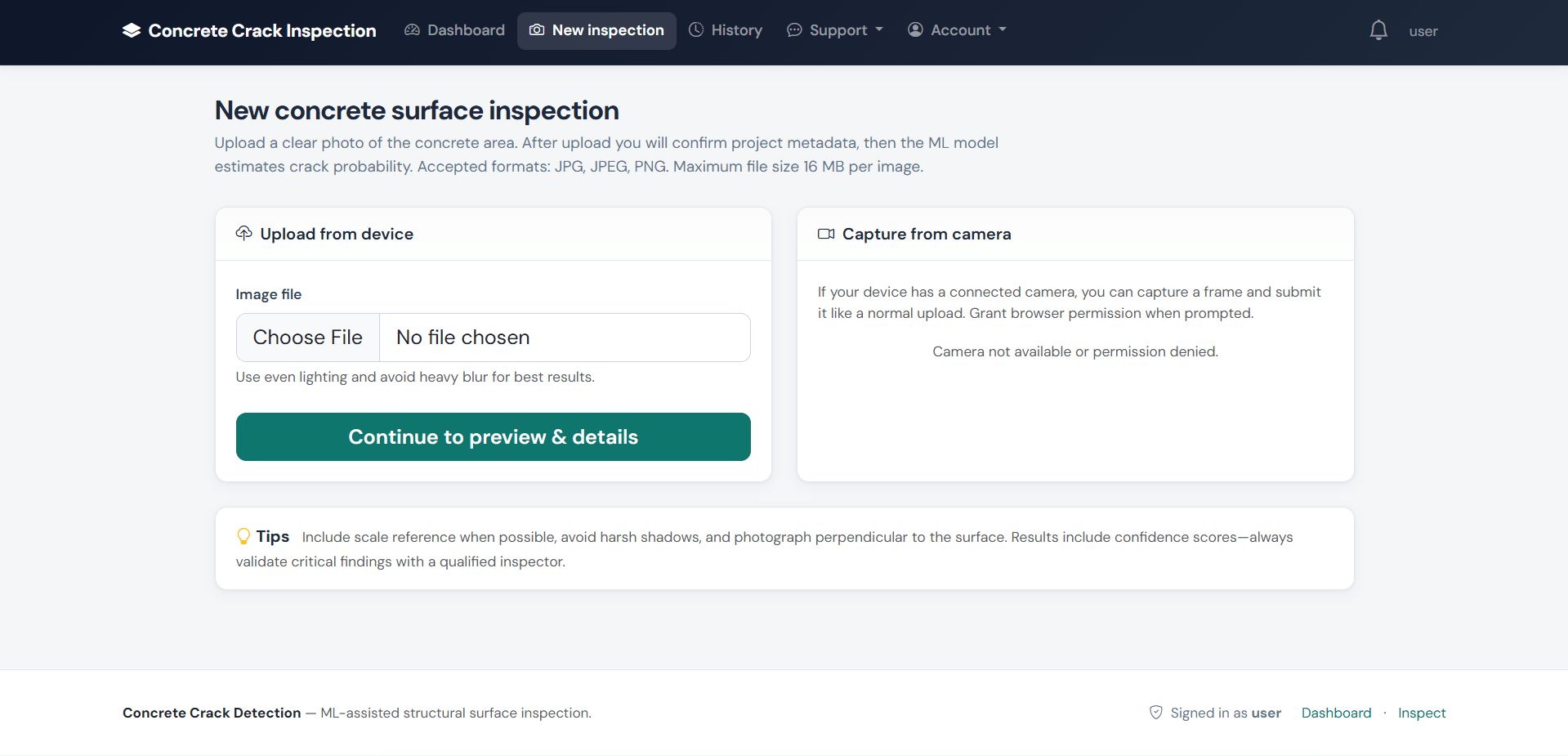
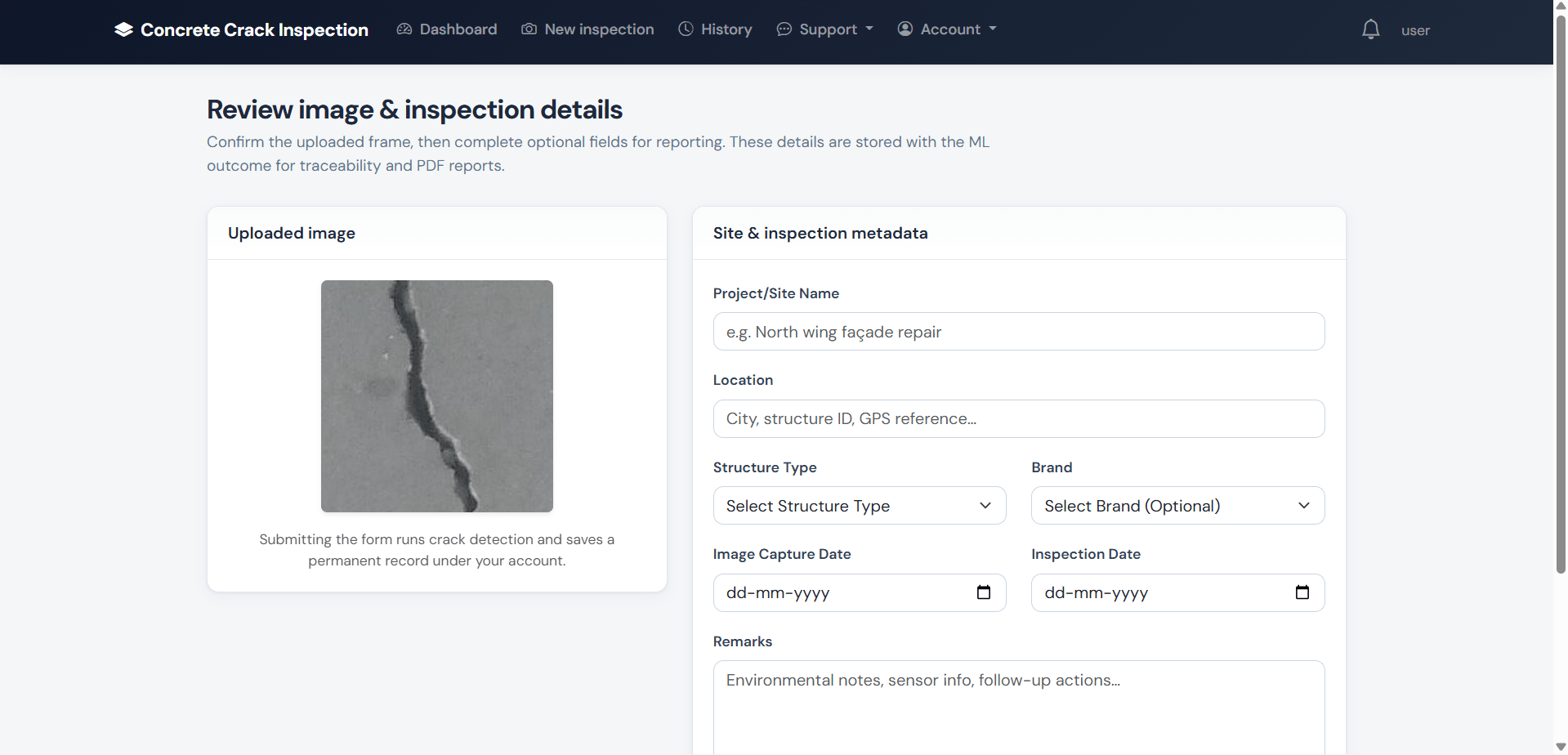
User Features
  • The Concrete Crack Detection project is designed to detect cracks in concrete structures using computer vision and machine learning techniques. The project was part of the L&T EduTech Hackathon under Shaastra, the tech fest of IIT Madras. Below are the detailed features and methodology of the project:

1. Problem Statement and Objective

  • Goal: To automate the process of damage surveillance of buildings by detecting cracks in concrete structures using machine learning models.
  • Context: Traditional manual inspection methods are time-consuming and prone to errors. Automated detection can help improve accuracy and efficiency in monitoring the structural health of buildings.

2. Dataset Information

  • Source: The dataset used is publicly available on Kaggle: Surface Crack Dataset.
  • Content: The dataset consists of images categorized into two classes: positive (images with cracks) and negative (images without cracks).
  • Size: Initially, the dataset had around 300 examples per class, which was later augmented to 3000 examples per class using data augmentation techniques.

3. Data Preprocessing and Augmentation

  • Bilateral Filtering:
  • Purpose: To remove salt-and-pepper noise while preserving the edges of the cracks.
  • Comparison: Initially, median filtering was used but did not yield satisfactory results as it blurred the edges. Bilateral filtering was chosen as it preserved edges better.
  • Morphological Operations:
  • Opening Operation: Used to remove small noise and amplify the difference between classes.
  • Technique: Single iteration of opening operation with a 3x3 kernel was applied.
  • Grayscale Conversion:
  • Reason: Grayscale conversion was performed to reduce computation time by approximately three times, as processing a single channel (grayscale) is faster than processing three channels (RGB).
  • Data Augmentation:
  • Techniques:
  • Perfect 90 and 180-degree rotations.
  • Horizontal and vertical flipping.
  • Minor brightness adjustments (around 10%) to increase dataset variability.
  • Objective: To increase the dataset size and improve the model’s generalization by generating more diverse training samples.

4. Modeling and Machine Learning Techniques

  • Model Architectures Tested:
  • ResNet Architecture: Selected for final predictions after testing multiple architectures due to its superior performance.
  • VGG16 Model: Also experimented with but found to be less effective than ResNet on this specific dataset.
  • Transfer Learning:
  • Approach: Utilized pre-trained models (ResNet and VGG16) and fine-tuned them for the crack detection task. Transfer learning was preferred over building custom models from scratch to leverage pre-existing feature extraction capabilities.
  • Performance Metrics: Achieved a perfect F1 score of 1.0, indicating that the model was able to perfectly classify the images into cracked and non-cracked categories.

5. Model Training and Evaluation

  • Training Process: Models were trained on the augmented dataset with a focus on achieving high accuracy and minimizing false positives and false negatives.
  • Evaluation: The final model (ResNet) was evaluated on a separate test set to ensure its performance was robust and reliable.

6. Deployment and Application

  • Potential Use Cases:
  • Automated monitoring of building structures, bridges, and other concrete constructions.
  • Integration into drones or handheld devices for real-time crack detection in field inspections.
  • Advantages:
  • Faster and more accurate than manual inspection.
  • Can be scaled to large infrastructure projects for continuous monitoring.

7. Challenges and Solutions

  • Noise Removal: Initial challenges in removing salt-and-pepper noise without losing important crack details were solved using bilateral filtering.
  • Data Imbalance and Augmentation: Addressed the small size of the dataset by performing extensive data augmentation to prevent overfitting and improve model robustness.

8. Conclusion and Future Work

  • Current Achievements: Successfully created a model that can detect cracks in concrete with high accuracy, achieving an F1 score of 1.
  • Future Enhancements:
  • Expanding the dataset with more diverse examples to improve model generalization.
  • Exploring real-time deployment in practical scenarios.
  • Integrating additional machine learning techniques to further refine detection capabilities.

9. Technologies and Libraries Used

  • Libraries: Python, TensorFlow, Keras, OpenCV, NumPy, Matplotlib, and scikit-learn.
  • Environments: Jupyter Notebooks for development and experimentation, and a dedicated Python virtual environment for managing dependencies.
  • This project demonstrates a comprehensive approach to using machine learning for practical applications in structural health monitoring, showcasing the power of modern image processing and deep learning techniques.
Other Features
How to run Concrete Crack Detection Using Machine Learning
  • Step 1: Navigate to the Project Directory

cd Concrete-Crack-Detection
  • Step 2: Set Up a Virtual Environment 

python -m venv crack-detection-env
source crack-detection-env/bin/activate # On Windows use `crack-detection-env\Scripts\activate`
  • Step 3: Install the Required Libraries

pip install -r requirements.txt 
  • Step 4: Download the Dataset 

  • The dataset is available at Kaggle.
  • Download the dataset and extract it to a folder, say data.
  • Place the data folder in the project directory
  • Step 5: Run the Jupyter Notebooks

  • 1.Launch Jupyter Notebook by typing:
jupyter notebook
  •  2. Open the concrete_crack_detection_processing_iitm_shaastra.ipynb or models_final1.ipynb notebook.
  • 3. Run each cell in the notebook sequentially. This will:
  • Load the dataset.
  • Preprocess the images using the specified methods.
  • Train the model using the processed data.
  • 4. Download the pre-trained model resnet_model1.h5 from (Google Drive), ensure that the model file is in the correct path in root directory


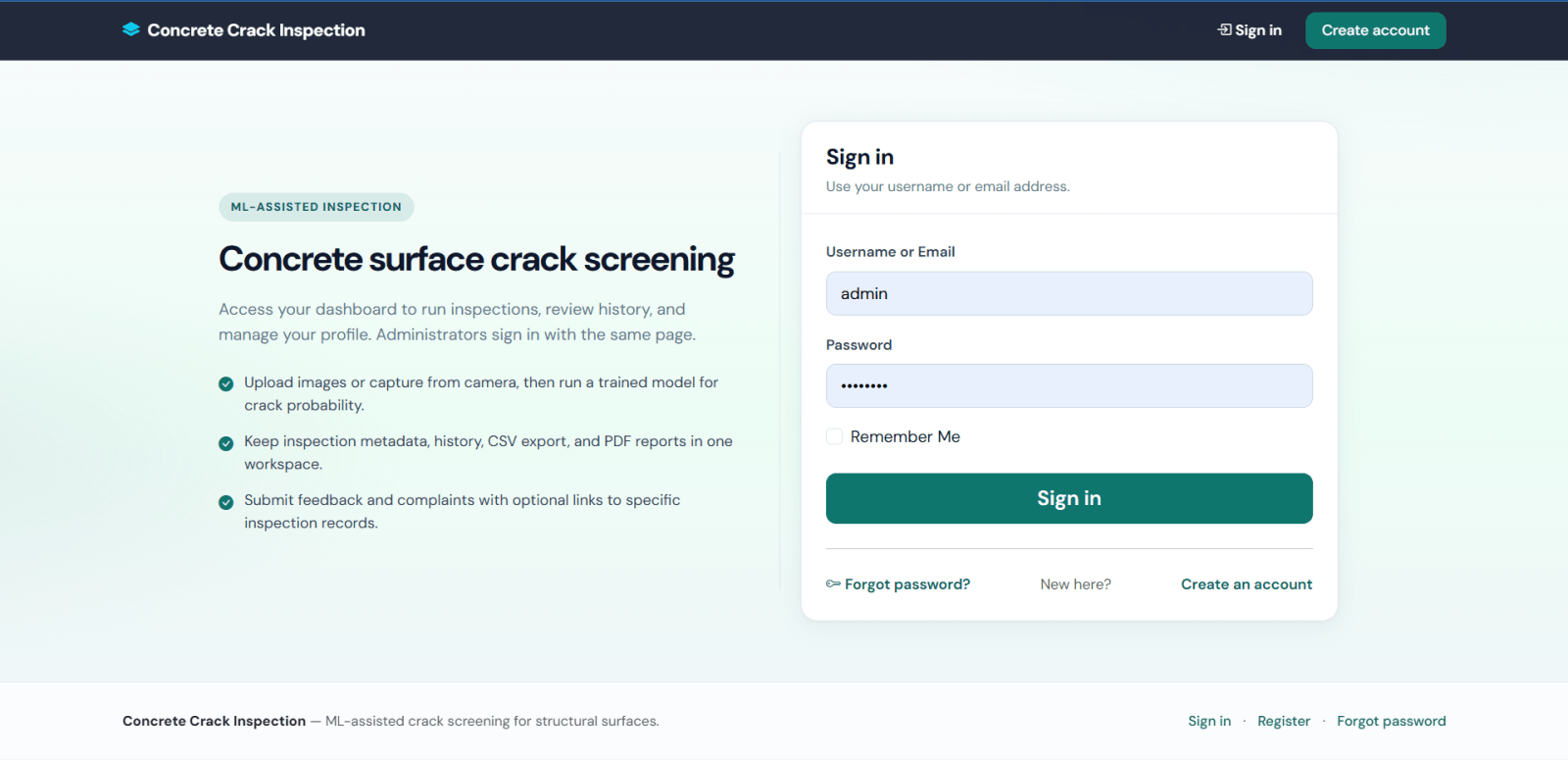
Credentials
Panel Email Username Password
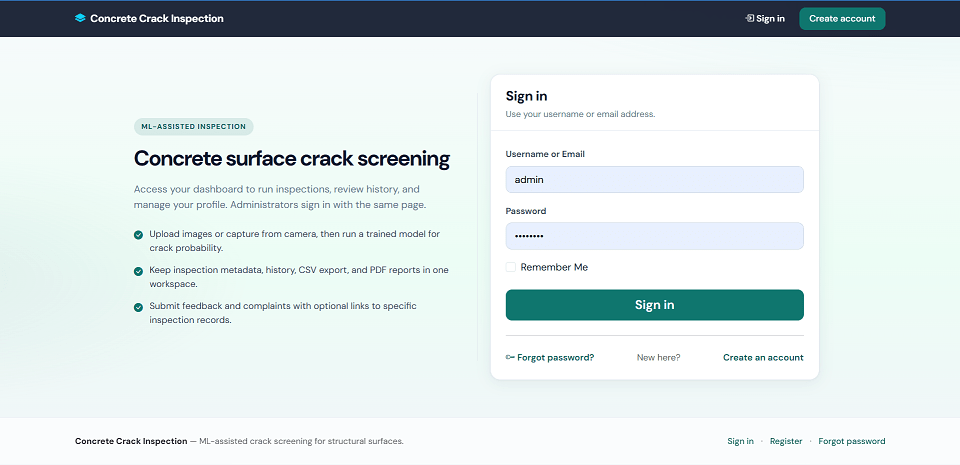
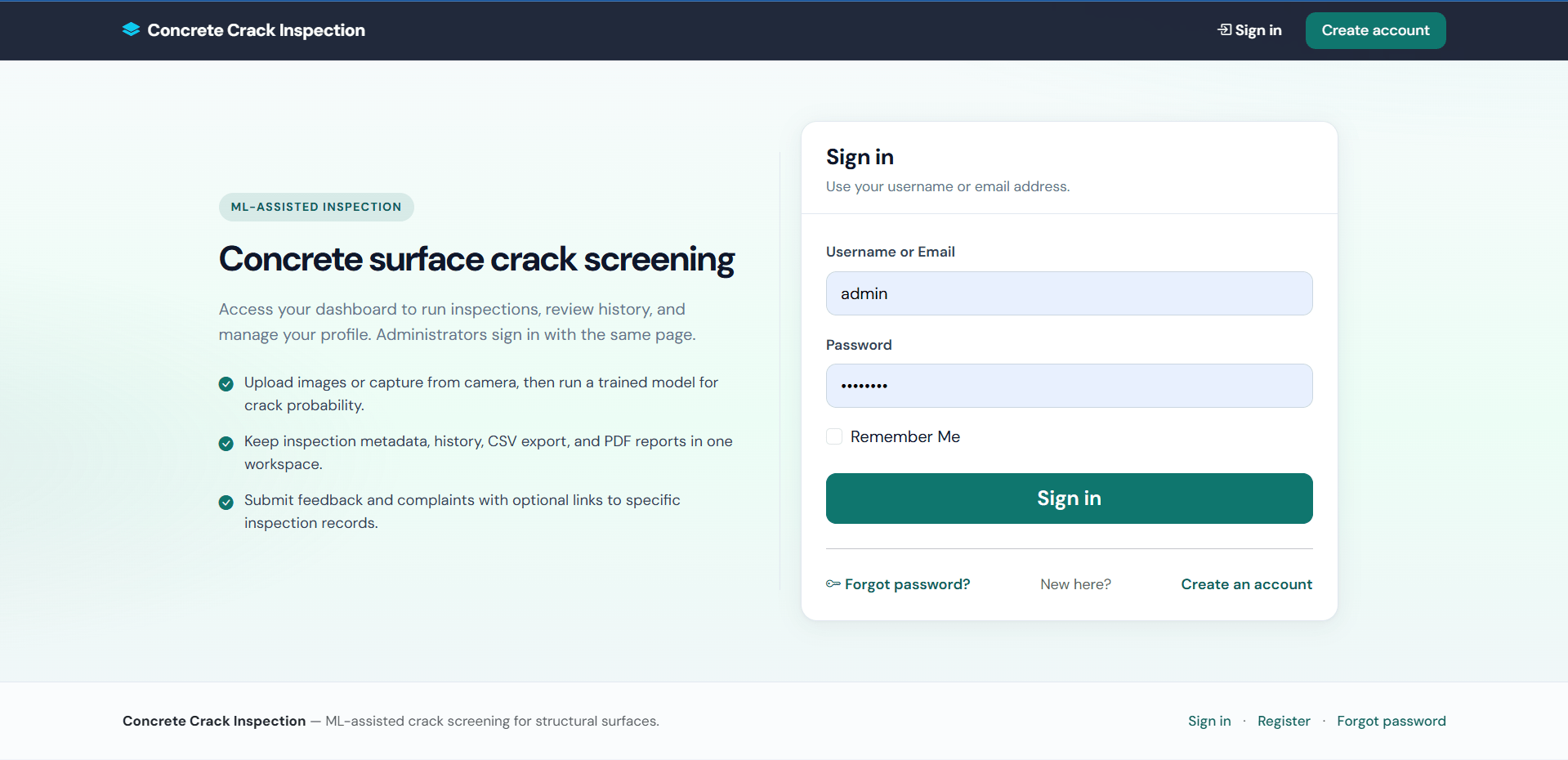
Admin [email protected] admin admin@123
User [email protected] User user@123
License
Concrete Crack Detection Using Machine Learning Source Code Tags
Concrete Crack Detection Using Machine Learning Source Code Download
Final Year Concrete Crack Detection Using Machine Learning Code for B.Tech
Final Year Concrete Crack Detection Using Machine Learning Code for M.Tech
Final Year Concrete Crack Detection Using Machine Learning Code for MCA
Final Year Concrete Crack Detection Using Machine Learning Code for BCA
Final Year Concrete Crack Detection Using Machine Learning Code for M.E.
Final Year Concrete Crack Detection Using Machine Learning Code for B.E.
Final Year Concrete Crack Detection Using Machine Learning Code for M.Sc
Final Year Concrete Crack Detection Using Machine Learning Code for B.Sc
Concrete Crack Detection Using Machine Learning Project with Documentation
Ready-to-Run Concrete Crack Detection Using Machine Learning Code
Customizable Concrete Crack Detection Using Machine Learning Source Code
Responsive Concrete Crack Detection Using Machine Learning Project Code
Concrete Crack Detection Using Machine Learning Code with Database
Best Final Year Concrete Crack Detection Using Machine Learning Code
Plagiarism-Free Concrete Crack Detection Using Machine Learning Code
Complete Concrete Crack Detection Using Machine Learning Code Package
Faculty Approved Concrete Crack Detection Using Machine Learning Code
FileMakr
Concrete Crack Detection
Machine Learning Project
Final Year Project
BCA Project
MCA Project
Engineering Students
ResNet Architecture
VGG16
Civil Engineering
Image Processing
Data Augmentation
Transfer Learning
Python
TensorFlow
OpenCV
Student Success
2024-2025 Batch
2025-2026 Batch
Automated Surveillance
EduTech
Source Code Download
Final Year Students
Recommended for you

Related & Popular Project Reports

Explore more final-year projects you might be interested in

Electronic Health Recognition Summarization Final Year Flask Project — Source Code

<p>MedSynapse EHR is a <strong>final year project</strong> built with Python Flask for students who want a healthcare-focused web application with document processing and clinical summarization features. This <strong>final year project</strong> allows users to add patients, upload PDF or TXT electronic health records, extract text, generate structured 8-section summaries, compare extracted content with generated sections, edit the final narrative, and download summary reports as PDF. The admin side of this <strong>final year project</strong> includes users, patients, EHR documents, summaries, medical categories, terms, diseases, medicines, reports, and branding settings. The system works with a heuristic summarizer by default and also supports optional Hugging Face Flan-T5 fine-tuning for advanced experimentation. MedSynapse EHR is suitable for a <strong>final year major project</strong> in Flask, healthcare software, NLP, or AI-assisted clinical documentation.</p>

Brain Tumor Detection Using Machine Learning — Source Code

Brain Tumor Detection Using Machine Learning Source Code project implements a U-Net model to segment brain tumors in MRI images. It focuses on identifying and classifying three types of brain tumors: meningioma, glioma, and pituitary tumors. The project uses the dataset from publicly available brain tumor segmentation data and applies deep learning techniques to accurately delineate tumor regions from MRI scans.

Brain Tumor Detection System using Python and Machine Learning — Source Code

<p><strong>NeuroScan</strong> is a college-level <strong>brain tumor detection web application</strong> built with <strong>Python Flask</strong>, <strong>SQLite</strong>, <strong>scikit-learn</strong>, and <strong>OpenCV</strong>. The system allows users to upload <strong>brain MRI images</strong>, preview scans, run <strong>brain tumor classification</strong>, and download <strong>PDF/TXT reports</strong>. It includes a complete <strong>user panel</strong> and <strong>admin dashboard</strong> with authentication, prediction history, model training, dataset management, reporting, and feedback handling.</p> <p>This project performs <strong>local machine learning inference</strong> without using any third-party API. The ML pipeline uses <strong>HOG features</strong>, <strong>image histogram analysis</strong>, <strong>edge detection</strong>, and a <strong>RandomForestClassifier</strong> for <strong>MRI image classification</strong>. It supports both <strong>binary classification</strong> such as <strong>Tumor / No Tumor</strong> and <strong>multiclass brain tumor classification</strong> depending on the training dataset.</p> <p>The project is ideal for <strong>final year students</strong>, <strong>machine learning beginners</strong>, <strong>Flask web development learners</strong>, and <strong>academic demonstration purposes</strong></p>

Dynamic Event Scheduling and Conflict Resolution System — Source Code

FestivalOS is a smart and scalable festival management web application developed using Python, Flask, SQLAlchemy, SQLite, Bootstrap 5, and scikit-learn. The system is designed for large-scale festival operations and helps manage events, venues, resources, participants, and schedule conflicts through an intelligent web platform. This project includes a public landing page, a secure admin console, and a dedicated user portal for attendees, volunteers, performers, coordinators, and administrators. The core highlight of the system is its constraint-aware event scheduling engine, conflict detection module, and machine-learning–assisted priority scoring for better slot recommendations. FestivalOS is an ideal final year college project for students looking to build a real-world event management and scheduling system using Flask and Python.

Fake News Detection System Using Django and Machine Learning — Source Code

<p>Fake News Detection is a Django web application that classifies news articles as Real or Fake using a hybrid machine learning model. The system uses TF-IDF vectorization with Logistic Regression and Random Forest for accurate fake news classification. Users can register, log in, check news by pasting text or article URLs, and view prediction history, analytics, and dashboard reports. The application also supports URL-based article extraction using BeautifulSoup and requests, model transparency with probability scores, admin management tools, staff dashboard access, and report visualization with charts. This project is ideal for demonstrating Django, machine learning, NLP, fake news detection, user authentication, admin panel development, and dashboard analytics in one complete web application</p>

Mental Health Chatbot Using Machine Learning and Flask — Source Code

<p><strong>MindCare</strong> is a <strong>mental health chatbot web application</strong> built with <strong>Python Flask and Machine Learning</strong>. It helps users with <strong>mental wellness support, mood tracking, self-assessments, chat history, and emotional analysis</strong>. The system uses <strong>NLP, TF-IDF, Logistic Regression, and rule-based response selection</strong> to generate chatbot replies from local training data. It also includes a powerful <strong>admin panel</strong> to manage users, chatbot training data, emotion labels, assessments, reports, and wellness content.</p> <p>This <strong>Flask mental health project</strong> is designed for <strong>academic projects, final year projects, portfolio websites, and machine learning demos</strong>. OpenAI integration is optional and can be enabled in code for AI-generated responses.</p>

Agricultural Monitoring and Crop Prediction System with Machine Learning — Source Code

<p><strong>AgriMonitor Pro</strong> is a Flask web application for <strong>smart agricultural monitoring</strong>, <strong>crop recommendation</strong>, <strong>yield prediction</strong>, and <strong>risk classification</strong> using <strong>machine learning</strong>. The system is designed for <strong>farmers</strong> and <strong>administrators</strong> to manage farms, record crop and soil data, train ML models locally, generate predictions, and download reports in <strong>CSV</strong> and <strong>PDF</strong> formats.</p> <p>This agriculture management system uses <strong>Python 3</strong>, <strong>Flask 3</strong>, <strong>SQLAlchemy</strong>, <strong>SQLite</strong>, <strong>pandas</strong>, and <strong>scikit-learn</strong>. It supports <strong>Random Forest classification and regression</strong>, dataset management, user management, farm monitoring, soil health tracking, analytics dashboards, and report generation with <strong>Matplotlib</strong> and <strong>ReportLab</strong>.</p> <p>The platform provides a guided farmer portal for adding farms, entering NPK and weather values, checking crop health, estimating yield, and reviewing prediction history. It also includes a powerful admin panel for managing users, datasets, model training, notifications, feedback, and data exports.</p> <p>This project is suitable for <strong>agriculture technology</strong>, <strong>farm management software</strong>, <strong>smart farming solutions</strong>, <strong>precision agriculture systems</strong>, and <strong>machine learning based crop advisory platforms</strong></p>

Skin Disease Detection Final Year using Machine Learning — Source Code

<p>DermaSense is a <strong>final year project</strong> built with Python Flask, TensorFlow/Keras, and SQLite for students who want a machine learning based healthcare web application. This <strong>final year project</strong> allows users to upload skin images, run CNN inference, view predicted disease labels with confidence scores, and maintain private prediction history. The system also supports disease information, precautions, medicine suggestions, optional Grad-CAM overlays, printable reports, and user profile management. The admin console of this <strong>final year project</strong> includes user management, prediction logs, disease catalog management, precautions, medicines, model upload, model activation, monitoring, and maintenance tools. With support for <code>.keras</code> and <code>.h5</code> models, DermNet-style class labels, and a demo model generator, DermaSense is suitable for a <strong>final year major project</strong> in machine learning, Flask, TensorFlow, image processing, or healthcare AI.</p>

Credit Card Fraud Detection Using Machine Learning — Source Code

Fraud Detection model based on anonymized credit card transaction. It is important that credit card companies are able to recognize fraudulent credit card transactions so that customers are not charged for items that they did not purchase. The datasets contains transactions made by credit cards in September 2013 by European cardholders. This dataset presents transactions that occurred in two days, where we have 492 frauds out of 284,807 transactions. The dataset is highly unbalanced, the positive class (frauds) account for 0.172% of all transactions.

What we provide

Project reports, source code, and PPTs tailored for final-year students. Explore, or message us for a custom build.