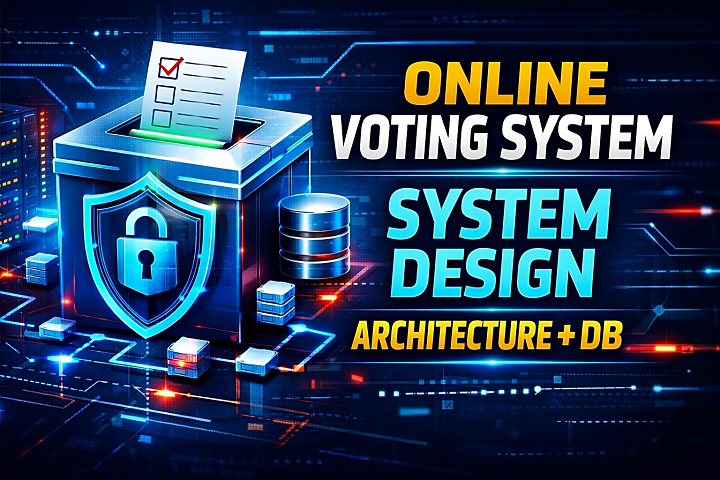
System Design for Online Voting System
Designing an online voting system is not just about creating a login form and a vote button. A good system design must ensure that only eligible users can vote, each voter can vote only once, results are counted correctly, and the system stays easy to explain in a final-year project report or viva.
Quick Answer
An effective system design for online voting system uses a modular web architecture with voter authentication, election management, candidate management, secure vote processing, result tabulation, and audit logging. For a final-year project, the best approach is a role-based web app with a clean database schema, one-vote-per-user constraint, election time controls, and a simple admin dashboard.
What Is an Online Voting System?
An online voting system is a digital platform that allows eligible users to cast votes electronically in a controlled election. In student projects, this usually means a college, department, class representative, or event-based election.
The goal is not to mimic a national election system in full complexity. The goal is to design a platform that demonstrates sound thinking in:
- authentication
- database design
- vote integrity
- result calculation
- reporting
- admin control
System Requirements and Assumptions
Before designing the architecture, define the project scope clearly.
Functional requirements
The system should support:
- voter registration and login
- admin login
- election creation and scheduling
- candidate creation and mapping
- eligibility checks
- vote casting
- duplicate-vote prevention
- result generation
- audit logs and reports
Non-functional requirements
A strong design should also consider:
- security
- availability during the voting window
- fast response time
- clear user interface
- data consistency
- basic scalability for multiple classes or departments
Project assumptions
For a final-year project, you can safely assume:
- users are pre-approved or manually verified
- elections are limited to one institution or campus
- traffic is moderate
- the system uses a relational database such as MySQL or PostgreSQL
High-Level Architecture of Online Voting System
A clean online voting system architecture can be divided into five layers.
1. Presentation layer
This is the frontend used by voters and admins.
It includes:
- registration page
- login page
- active election page
- candidate list
- vote confirmation screen
- admin dashboard
- result dashboard
2. Application layer
This layer contains the business logic.
It handles:
- authentication
- election lifecycle rules
- candidate mapping
- vote validation
- result calculation
- report generation
3. API/service layer
This layer exposes backend endpoints such as:
- /register
- /login
- /elections/active
- /candidates
- /vote
- /results
- /admin/elections
Using a simple REST API design makes the system easier to build, test, and explain.
4. Database layer
The database stores persistent records for:
- users
- elections
- candidates
- votes
- constituencies
- logs
5. Security layer
This layer protects the system through:
- password hashing
- session or JWT-based authentication
- role-based access control
- input validation
- duplicate-vote prevention
- audit logging
Main Modules in Online Voting System
Voter registration and verification
This module stores voter details and controls whether a user is eligible to participate.
Authentication and authorization
The system should separate voter and admin roles. RBAC prevents normal users from accessing election setup, candidate editing, or report controls.
Election management
Admins should be able to:
- create elections
- define start and end dates
- assign constituencies
- activate or close elections
Candidate management
This module stores:
- candidate name
- party or group
- symbol or image
- constituency
- election mapping
Vote casting module
This is the core system component. It must:
- check election status
- verify voter eligibility
- verify that the voter has not already voted
- insert the vote atomically
- return a success confirmation
Result tabulation module
This module calculates:
- votes per candidate
- turnout percentage
- winner
- ranking by vote count
Audit and reporting module
This improves trust and helps in viva explanation. It can record:
- login attempts
- admin changes
- vote timestamps
- result publication actions
Online Voting System Database Design
A clean schema makes implementation easier and improves viva performance.
|
Table Name |
Purpose |
Key Fields |
|
users |
Stores voter and admin accounts |
user_id, name, email, password_hash, role, status |
|
elections |
Stores election details |
election_id, title, start_time, end_time, status |
|
candidates |
Stores candidate data |
candidate_id, election_id, name, party, symbol |
|
constituencies |
Optional grouping |
constituency_id, name |
|
votes |
Stores each valid vote |
vote_id, election_id, voter_id, candidate_id, voted_at |
|
audit_logs |
Tracks actions |
log_id, user_id, action, timestamp |
Critical database rules
- Use a unique constraint on (election_id, voter_id) in the votes table.
- Never store passwords in plain text.
- Add indexes to election and voter lookup fields.
- Use foreign keys to maintain integrity between elections, candidates, and votes.
Vote Workflow and Request Lifecycle
A strong answer for system design should explain not only modules, but also flow.
- Admin creates an election.
- Admin adds candidates.
- Voter registers and gets verified.
- Voter logs in during the active election window.
- System fetches eligible candidates.
- Voter selects one candidate and confirms the vote.
- Backend starts a transaction.
- System checks whether a vote already exists for that voter and election.
- If not, the system inserts the vote and commits the transaction.
- Result engine updates counts through query-based tabulation.
- Admin publishes results.
This flow is ideal for ER diagrams, DFDs, and sequence-diagram explanations.
How to Prevent Duplicate Voting
Duplicate-vote prevention is the most important technical requirement.
Use three layers of protection:
- frontend confirmation screen to reduce accidental double-clicks
- backend validation before insert
- database-level unique constraint for final enforcement
This matters because two near-simultaneous requests can bypass frontend checks. The database must remain the final source of truth.
Security, Privacy, and Design Tradeoffs
A student project does not need full national-election complexity, but it should still show solid security thinking.
Essential protections
- hashed passwords
- secure session handling
- RBAC
- input validation
- audit logs
- election time-window checks
Important design tradeoff: secrecy vs auditability
A real-world election system must protect ballot secrecy while still allowing auditability. In student projects, avoid overclaiming anonymity if the vote table directly stores voter ID and candidate ID together. Be honest: this design is suitable for demonstration and controlled academic use, not public election deployment.
Tech Stack and Implementation Guide
A practical stack for a final-year project:
- frontend: HTML, CSS, JavaScript or React
- backend: PHP, Node.js, Java, or Python
- database: MySQL or PostgreSQL
- auth: session-based auth or JWT
- deployment: localhost, college server, or cloud VM
Step-by-step implementation
- Define the project scope and user roles.
- Design the ER diagram and tables.
- Build registration and login.
- Build admin election and candidate forms.
- Build voter dashboard and active election view.
- Implement vote API with transaction logic.
- Build results dashboard.
- Test invalid login, expired election, repeat voting, and missing candidate cases.
Common Mistakes to Avoid
- allowing repeat votes
- storing plain-text passwords
- mixing voter and admin permissions
- accepting votes outside the election window
- skipping logs and reports
- claiming blockchain or enterprise-grade security without implementation evidence
Expert Tips for Viva and Report Writing
- Explain your system as HLD first, then LLD.
- Show one practical example of vote submission flow.
- Mention why database constraints are necessary.
- Clearly separate current scope and future scope.
- Include ER diagram, DFD, flowchart, and architecture diagram in your report.
For students building related systems, it also helps to review an online election system project report, compare module structures with a project modules guide, and study database flow patterns from student management system documentation.
FAQ
What is system design for online voting system?
It is the process of planning the architecture, modules, database, workflow, and security rules of a digital voting platform.
What modules are required in an online voting system?
The core modules are voter registration, authentication, candidate management, election management, vote casting, result calculation, and audit reporting.
Which database is best for an online voting system project?
MySQL and PostgreSQL are both strong choices because they support structured tables, constraints, indexing, and transactions.
How do you prevent duplicate voting?
Use backend checks plus a unique database rule on voter and election combination. Database enforcement is essential.
What diagrams should be included in the report?
Include ER diagram, DFD, flowchart, use case diagram, and a high-level architecture diagram.
Is blockchain necessary for an online voting system project?
No. For most academic projects, a secure relational database design is enough. Blockchain can be discussed as future scope.
How can I explain the project in viva?
Explain the problem, architecture, modules, database schema, vote workflow, duplicate-vote prevention, and result generation in a simple sequence.
Conclusion
A strong system design for online voting system is simple, modular, secure, and easy to defend academically. The best project design includes clear user roles, election lifecycle control, secure vote submission, result tabulation, and audit logging. That combination is enough to make your report look professional and your viva answers sound technically mature.
To take the next step, explore final year project ideas, strengthen your documentation with a final year project viva preparation guide, or move directly to a complete online election system project report if you want a faster implementation path.